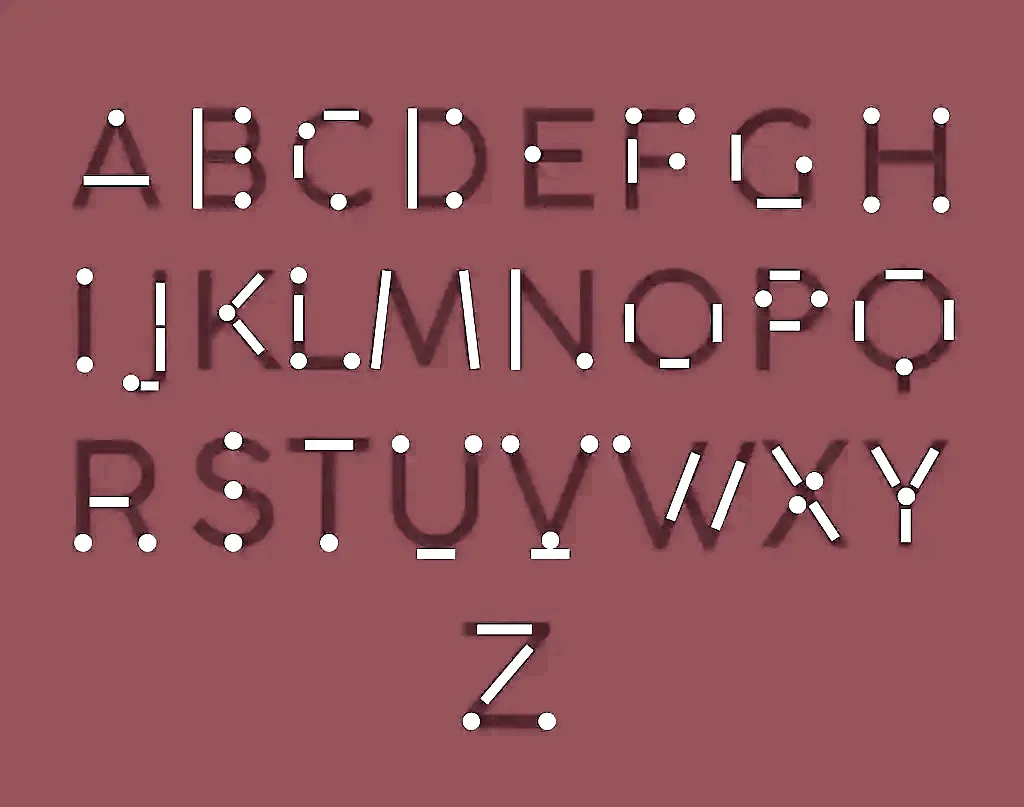
Complete Morse Code Alphabet Chart
Interactive A-Z reference with click-to-play audio. Learn all 26 letters, 10 numbers, and punctuation marks in International Morse Code. Perfect for beginners and advanced learners.
Quick Answer: The Morse Code Alphabet
The morse code alphabet use a unique combination of dot ( . ) & dash ( - ) for each letter A-Z . The common letter have the shortest code: E is one dot (.), T is one dash (-), A is dot-dash (.-), and I is two dots (..). Numbers 0-9 are five symbol long. 0 is five dashes (-----), 5 is five dots (.....). This technique was built to make the transfer of often-used letters faster.
Interactive Morse Code Alphabet with Audio
Click any character card below to hear its morse code pattern. Use this chart to memorize letters, numbers, and symbols.
A-Z Letters
0-9 Numbers
@# Punctuation
Click any card to hear the morse code audio.
Memory Tricks to Learn the Morse Code Alphabet
Use these mnemonics to memorize the morse code alphabet faster. Each phrase matches the rhythm of the dots and dashes.
One-Letter Words
- A (.-) = "a-PART"
- B (-...) = "BEAR-er-ry"
- C (-.-.) = "CO-ca-CO-la"
- D (-..) = "DAN-ger-ous"
- E (.) = "eh" (the shortest!)
- F (..-.) = "for-it-IS"
- G (--.) = "GOOD-BYE-now"
More Letter Patterns
- H (....) = "hip-pi-ty-hop"
- I (..) = "i-TCH"
- J (.---) = "ju-LYYY"
- K (-.-) = "KA-me-ra" (also SOS pattern)
- L (.-..) = "li-ON-el"
- M (--) = "MMmm"
- N (-.) = "NO-vac"
Letters O through U
- O (---) = "OHHH"
- P (.--.) = "pu-pp-Y-POW"
- Q (--.-) = "QUE-bec-CO"
- R (.-..) = "ro-ta-TION"
- S (...) = "si-si-si" (also SOS!)
- T (-) = "TAP" (the single dash)
- U (..-) = "un-der-LINE"
Letters V through Z
- V (...-) = "vic-tor-EE"
- W (.--) = "wi-WI-wi"
- X (-..-) = "x-MAS-x-MAS"
- Y (-.--) = "yo-YO-yo"
- Z (--..) = "ZEN-zon-za"
Pattern Recognition Tips to Master the Morse Code Alphabet
Instead of memorizing dot and dash as visual shape, learn these structural pattern. Your brain will recognize letter as sound "chunk" much faster.
Start with E and T
E (.) and T (-), the shortest symbol and make up over 30% of English text. Learn these two first, then build outward.
E = . T = - Reverse Letter Pairs
Several letters are reverses of each other. If you know A (.-), you already know N (-.). Same for D (-..) and U (..-), and G (--.) and W (.--).
Group by Symbol Count
Letter cluster by how many dot/dash they use. The 1-symbol groups has just E and T. The 2-symbol groups has A, I, M, and N. The 3-symbol groups has 8 letters. The 4-symbol groups has the most letters.
Numbers Follow a Sequence
Morse code numbers 1-5 start with dots and add dashes. Numbers 6-9 start with dashes and add dots. Zero is all dashes. Once you see the sequence, memorization becomes trivial.
Punctuation Patterns
Common punctuation marks use repeated sequences. The period (.) is .-.-.-, the comma (,) is --..--, and the question mark (?) is ..--... Notice how these "feel" like their shape or rhythm.
. = .-.-.- , = --..-- ? = ..--.. Listen, Don't Count
The biggest mistake beginners make is counting dots and dashes. At 20+ WPM, each letter becomes a unique "sound shape" in your mind - just like recognizing a song from the first few notes. Use our audio playback to train your ear, not your eyes.
How to Memorize the Morse Code Alphabet
Start with E, T, A, I
These four letter make up over 30% of English texts. E in morse code is just a dot (.), T is a dash (-), A is .-, and I is ... Master these first.
Learning the Number Pattern
Each morse code number follows a set schema of fives, 1 is .---- (one dot, four dashes equals 5), 3 is ...-- (3 dots 2 dashes equaling to five), 0 is ----- (five dashes). The pattern is easy to remember once you see it.
Practicing with Audio
Click any card in our interactive chart above to hear the audio pattern. Listening while reading the dots and dashes creates stronger memory associations.
Use the Mnemonics
The memory phrases above (like "CO-ca-CO-la" for C) match the rhythm of the dots and dashes. Say them out loud while studying the chart.
Morse Code Alphabet Chart