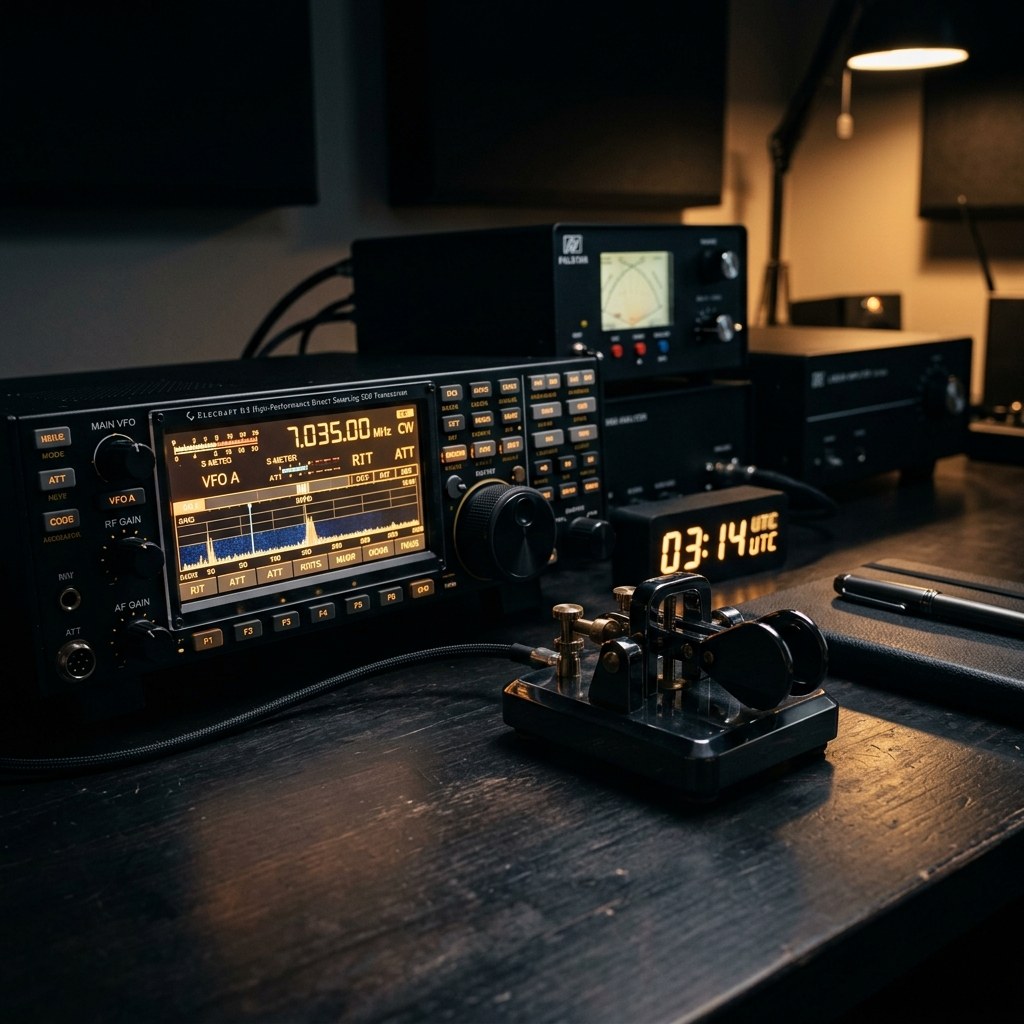
Amateur radio (HAM radio) and Morse code are historically inseparable. Even though licensing exams no longer mandate Morse code tests, ham radio morse code (referred to as CW, or Continuous Wave) remains one of the most popular operating modes on HF bands. Let's explore why Morse code is still king of the airwaves.
The CW Advantage: Why Voice Can't Compare
Why do HAM radio operators use Morse code when voice and digital modes exist? The answer lies in physics. A Morse code signal occupies a tiny fraction of the bandwidth of a voice signal (only 100Hz compared to 2400Hz). This means all of your transmitter's power is concentrated into a highly narrow beam. As a result, low-power Morse code signals (QRP) can cut through noise and travel across the globe under band conditions where voice is completely unreadable.
Standard HAM Abbreviations and Q-Codes
To make transmissions faster, HAM operators use standard abbreviations and Q-codes instead of spelling out whole words. Here are some of the most common shortcuts:
- CQ: Calling any station (a general call)
- DE: "From" (e.g. CQ DE K1XXX means calling any station, from K1XXX)
- QSL: Message received and understood
- QTH: My location / home town
- 73: Best regards
Getting Licensed and Starting
To transmit on amateur radio bands, you need to pass a simple regulatory exam and obtain a HAM license from your local authority (like the FCC in the US). Once licensed, you can buy a simple, inexpensive QRP transceiver and a straight key to start sending ham radio morse code messages across the continents! Not sure which key to buy? Compare straight keys, paddles and bugs first.
Get Ready by Training Online
Before you jump onto the live radio waves, practice copying and sending letters in a controlled environment. Use our specialized Auditory Trainer Tool to build your ears to copy callsigns at 15-20 WPM. It is the perfect preparation to ensure you feel confident during your first live on-air contacts!