Morse Code History: 1832 to 2026
From Samuel Morse's first telegraph wire to submarine cables, Titanic's SOS, WWII radio rooms, and the U.S. Navy's 2022 revival — the complete timeline of dots and dashes that changed the world.
By MorseCoder · August 2026
Quick Answer: Morse Code History
Morse code history begins in 1832 when Samuel Morse conceived the electromagnetic telegraph aboard the ship Sully. With Alfred Vail's engineering, the first public message — What hath God wrought — crossed 40 miles of wire on May 24, 1844. European nations standardized International Morse in 1851; submarine cables linked continents by 1866. Titanic's 1912 SOS drove maritime radio law. WWII made Morse a strategic weapon. Commercial telegraphy ended around 2006, but amateur radio, Navy training (revived 2022), and tools like our free translator keep the code alive in 2026.
What is Morse Code History?
Morse code history is the story of how Samuel Morse and Alfred Vail turned electrical pulses into an alphabet of dots and dashes — spanning land-line telegraphs, transatlantic cables, wireless radio, wartime communications, commercial decline, and modern amateur radio persistence.
Samuel Morse & Alfred Vail: The Inventors
Samuel Finley Breese Morse (1791–1872) was already a respected portrait painter when a conversation aboard the packet ship Sully in 1832 sparked his obsession with instant long-distance communication. Morse learned that electromagnetism could carry signals through wire — and he spent the next decade turning that insight into a working system.
Alfred Vail (1807–1859), a skilled mechanic at his family's Speedwell Iron Works in Morristown, New Jersey, became Morse's indispensable partner. While Morse handled patents, publicity, and Congressional lobbying, Vail redesigned the register, perfected the key, and — critically — expanded the original numeric code into a full alphabet. Vail's frequency analysis assigned shorter codes to common English letters: E became one dot, T one dash. That Huffman-like efficiency still helps beginners today.
Joseph Henry, later the first secretary of the Smithsonian, contributed relay designs that let signals travel beyond a single wire's resistance. Together, the trio proved that language could ride on electricity — a revolution comparable to the internet in its own century.
May 24, 1844: The First Message
On May 24, 1844, in the chamber of the U.S. Supreme Court (then housed in the Capitol basement), Morse sent the Bible verse "What hath God wrought" to Alfred Vail waiting at the Mount Clare station of the Baltimore and Ohio Railroad — roughly 40 miles away.
"What hath God wrought" — Numbers 23:23
Annie Ellsworth, the young daughter of Morse's friend Henry Ellsworth, chose the phrase. Within hours, newspapers reprinted the event. Congress had funded the experimental line with $30,000; this single transmission justified every penny and launched an industry that would shrink the world.
Hear how that message sounds in International Morse using our translator — type the phrase and click Play.
Details the timeline usually skips
Why E is one dot
Vail’s frequency analysis gave the shortest codes to the most common English letters. E (.) and T (-) still make early learning faster — the same Huffman-like idea as modern compression. Deeper dive: frequency analysis.
POW tap code (Vietnam)
American POWs in Hanoi communicated through walls with a related 5×5 tap grid — not ITU Morse, but the same lesson: a simple rhythmic code survives when every other channel fails.
Last Western Union telegram
Western Union ended commercial telegram service in the U.S. on January 27, 2006. Amateur radio CW never stopped — the skill moved off the land-line sounder and onto HF.
SOS has no acronym
The ITU chose ... --- ... because the rhythm is unmistakable through noise, light, or tapping — not because it stands for “Save Our Souls.” Full pattern and myth: SOS guide.
American vs. International Morse: The Great Divergence
The code Morse and Vail created for American land-line telegraphs — often called American Morse or Railroad Code — differed from the version Europe adopted. American operators used variable-length dashes and internal spaces within characters. International Morse (Continental Code), standardized in 1851, fixed timing: one dot length, one dash equals three dots, standardized gaps.
When Guglielmo Marconi's wireless telegraphy took off in the 1890s, International Morse won because fixed timing survives noise, fading, and weak signals better. Every ham exam, Navy training program, and tool on morsecoder.us uses International Morse per ITU-R M.1677-1 — not American Morse.
Submarine Cables & the Wired World
Land telegraphs connected cities; submarine cables connected continents. Cyrus Field's Atlantic Telegraph Company laid the first transatlantic cable in 1858 — Queen Victoria's 98-word message to President James Buchanan took 16 hours to transmit before the cable degraded. The 1866 cable, built with improved insulation and the SS Great Eastern, finally delivered reliable service.
By the 1870s, a web of undersea lines linked Europe, North America, India, and Australia. News that once traveled by ship for weeks arrived in hours. Reuters, AP, and other wire services built empires on Morse traffic. Operators developed "hog-Morse" errors (misheard characters) and proverbs about the speed of cable — the Victorian internet, pulsing in dots and dashes beneath the ocean floor.
Submarine cable operators eventually migrated to teletype and digital multiplexing, but Morse remained the human-readable fallback for decades — the same pattern radio operators would later copy by ear.
Titanic, SOS & Maritime Radio Law
At 12:17 AM on April 15, 1912, Titanic's senior wireless operator Jack Phillips tapped out CQD — the Marconi company's established distress call — followed by SOS (... --- ...). Junior operator Harold Bride survived to testify that Phillips worked until water flooded the radio room.
The RMS Carpathia, 58 miles away, responded to the Morse distress traffic and rescued 705 survivors. The disaster exposed gaps in radio regulation: ships carried wireless sets but no requirement for 24-hour monitoring. The International Convention for the Safety of Life at Sea (SOLAS) and subsequent radio treaties mandated continuous watch, standardized distress procedures, and eventually GMDSS — all rooted in lessons from that night of Morse in the North Atlantic.
Read the full story of the Titanic Morse code messages, minute by minute.
World War II: Morse on Every Front
Both Allied and Axis forces treated skilled Morse operators as strategic assets. Naval convoys relied on CW for ship-to-ship coordination when voice could be intercepted. Bomber crews learned recognition of friendly beacon identifiers. Resistance networks in occupied Europe used compact radio sets — often crystal receivers copying Morse from BBC or OSS transmitters.
The U.S. Army and Navy trained thousands of radiomen through programs like the Navy's V-12 and specialized Morse schools. Speed targets exceeded 25 WPM for intercept operators who copied encrypted traffic. After the war, many veterans earned amateur radio licenses and became the backbone of post-war ham CW culture — a direct lineage to today's contest stations and DXpeditions.
Decline of Commercial Telegraph
The telephone (1876), telex networks, fax, and email each ate away at Morse telegraphy. Western Union sent its last commercial telegram in the United States on January 27, 2006 — a bittersweet bookend to the industry Morse founded. India's Bharat Sanchar Nigam Limited ended telegram service in 2013.
Railroad telegraphers, who once used American Morse to control train movements, were replaced by centralized traffic control and radio. The sound of a land-line sounder clicking out dots and dashes faded from daily life — but the code itself did not die. It had already migrated to a medium that needed no wires at all.
Amateur Radio: Where Morse Never Stopped
While commercial telegraphy declined, amateur radio operators kept Continuous Wave (CW) mode alive on HF bands. CW punches through noise and interference better than voice at the same power — a 5-watt QRP station can work continents when conditions align. Organizations like ARRL, CW Academy, and contest groups (CQ WW, ARRL DX) celebrate speed, accuracy, and the craft of copying by ear.
The FCC dropped Morse as a licensing requirement for U.S. amateur exams in 2007, yet interest surged rather than collapsed. New operators discover CW for DX chasing, low-power operating, emergency preparedness, and the sheer satisfaction of a mode that rewards daily practice. Our free trainer mirrors how hams actually learn: Koch method, QSO simulation, and Farnsworth spacing.
U.S. Navy 2022 Revival
After roughly two decades without formal Morse instruction, the U.S. Navy reintroduced CW training in 2022. The rationale is straightforward: in GPS-denied or satellite-jammed environments, a skilled radioman with a simple transmitter can pass traffic that complex digital systems cannot. Morse requires minimal bandwidth, minimal power, and human judgment — qualities that matter in contested electromagnetic battlespaces.
For operators who still use CW, this revival validates what the ham community never forgot: Morse is a backup channel when everything else fails. It is not nostalgia — it is resilience engineering.
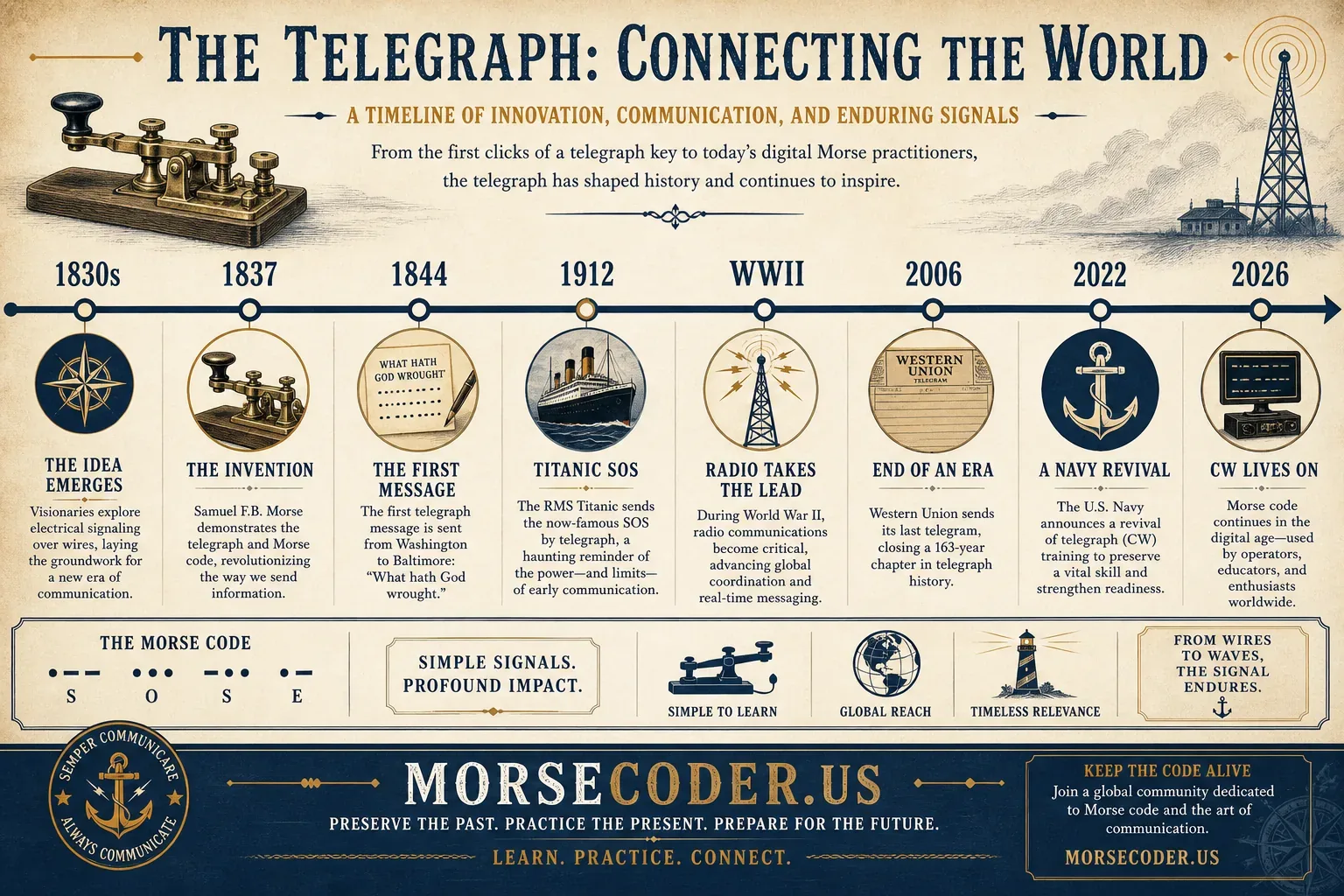
Morse Code History Timeline
The Idea Takes Shape
Samuel Morse, returning from Europe aboard the Sully, sketches the concept of an electromagnetic telegraph. He partners with Alfred Vail and Joseph Henry to build working prototypes.
First Demonstration
Morse and Vail demonstrate the telegraph publicly, sending messages over 10 miles of wire at Speedwell Iron Works, Morristown, New Jersey.
First Official Message
Congress funds a 40-mile line from Washington to Baltimore. Morse sends What hath God wrought from the Capitol — the birth of long-distance electronic communication.
International Morse Standardized
European nations adopt Continental Code at a conference in Dresden. Fixed timing replaces American Morse's variable dashes, setting the foundation for radio-era CW.
First Transatlantic Cable
The first successful submarine cable links Ireland and Newfoundland. Queen Victoria and President Buchanan exchange congratulatory messages — though the cable fails within weeks.
Reliable Atlantic Cable
A durable transatlantic cable begins permanent service. Morse code becomes the language of global commerce, news agencies, and diplomacy.
Wireless Morse
Guglielmo Marconi transmits Morse across the English Channel without wires. Maritime and military radio adopt CW as their primary mode.
Titanic & SOS
RMS Titanic sends CQD and SOS distress signals. The tragedy drives international radio safety regulations including 24-hour watch requirements.
WWII Communications
Allied and Axis forces rely on Morse for ship-to-shore, air-to-ground, and resistance networks. Operators become strategic assets.
Last U.S. Commercial Telegram
The final commercial Morse telegram in the U.S. is sent before Western Union fully transitions away from telegraph service (formally ending in 2006).
Gboard Morse Input
Google adds Morse code typing to Gboard, enabling accessibility for users with limited mobility — a modern everyday use case.
Navy CW Revival
The U.S. Navy reintroduces Morse code training for sailors as backup communication when GPS and satellite systems are unavailable or jammed.
Living Heritage
Ham radio CW contests, Navy training, VOR beacon IDs, Gboard accessibility, and free online tools like morsecoder.us keep the code active for a new generation.
Prefer a visual embed? See our Morse code history infographic.
Why Morse Code History Matters in 2026
Emergency Signaling
SOS (... --- ...) remains the universal distress pattern for light, sound, and radio. History teaches why three-of-anything signals distress.
Ham Radio Heritage
Every CW contact echoes WWII radiomen and telegraph operators. Understanding history deepens respect for the mode.
Accessibility Innovation
Gboard Morse input (2018) proves a 184-year-old code can serve modern disability technology.
Resilient Communications
Navy revival and prepper communities share one lesson from telegraph history: simple codes survive infrastructure collapse.
People Also Ask
How old is morse code?
Morse code is nearly 194 years old as of 2026 — conceived in 1832, first demonstrated in 1838, and first publicly transmitted in 1844.
What ended the telegraph era?
Telephone networks, fax machines, email, and digital switching replaced land-line telegraphy. Submarine cables shifted to voice and data. The last major commercial telegram services closed in the 2000s.
Why did the Navy bring back Morse training?
The U.S. Navy reintroduced CW instruction in 2022 as a satellite-independent backup for contested electromagnetic environments where digital systems may fail.
Morse Code History — Frequently Asked Questions
Experience Morse Code Yourself
History comes alive when you hear the code. Translate any phrase with real CW audio — free, no signup.