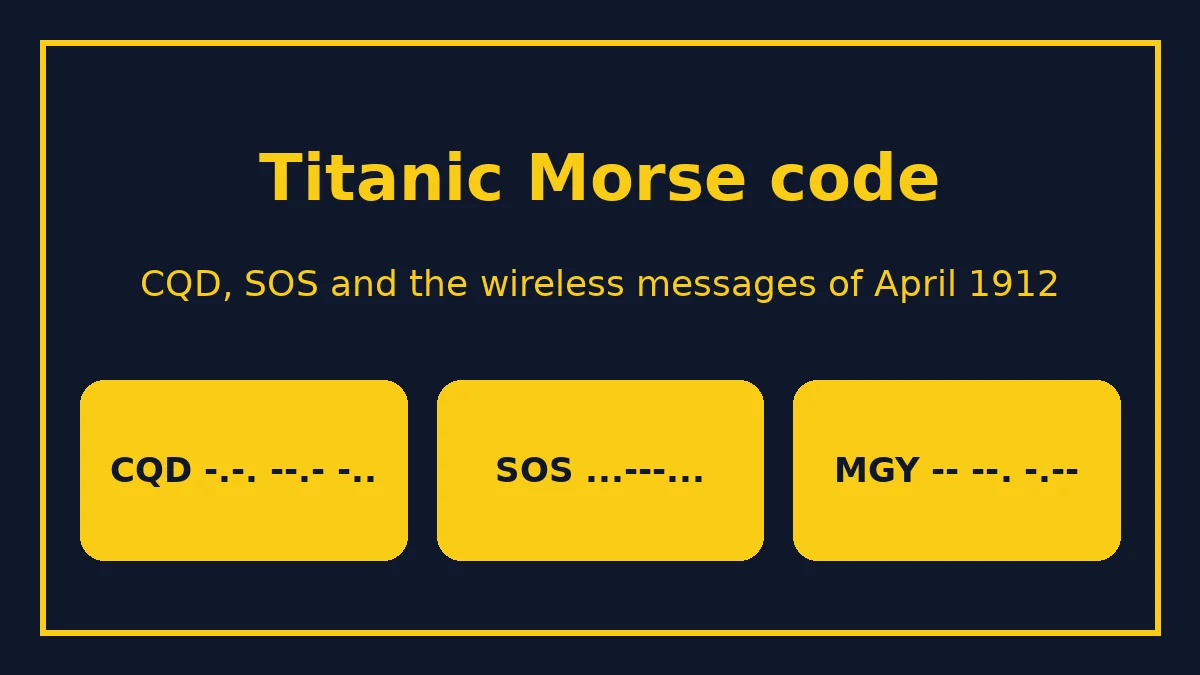
Titanic Morse code in one line: after the ship hit an iceberg at 11:40 p.m. on April 14, 1912, wireless operators Jack Phillips and Harold Bride sent the distress call CQD (-.-. --.- -..) and later SOS (... --- ...) under the ship's call sign MGY (-- --. -.--). The Carpathia, 58 miles away, heard them and turned to help. This guide walks through what was sent, when, what each signal means in Morse, and the myths that still circulate.
You can type any of the messages below into the Morse code translator to hear how they sounded, or check single letters on the Morse code chart.
The short version
- Call sign: MGY was Titanic's wireless identity. Every message began with it.
- First distress call: the British inquiry records CQD going out at about 12:15 a.m. ship's time on April 15.
- SOS: the inquiry's wireless table shows Titanic calling the Olympic with S.O.S. at about 12:45 a.m. Both calls were used that night.
- Who heard it: the Carpathia, the Frankfurt, the Olympic, the Mount Temple, the Virginian, the Cape Race shore station and others.
- Who did not: the Californian, the closest ship. Its only wireless operator had gone to sleep.
- Last signal: a faint "C.Q." heard by the Virginian at about 2:17 a.m., just minutes before the ship sank.
Who were the Titanic's wireless operators?
Titanic carried two wireless operators. They were employees of the Marconi company, not White Star Line crew. Jack Phillips was the senior operator and Harold Bride was his junior. Their main job was paid passenger messages (telegrams to and from shore), but they also handled navigation warnings from other ships.
Phillips stayed at the key until the power was almost gone and did not survive. Bride survived and gave evidence to both the American and British inquiries. His testimony, together with the logs of the ships that heard Titanic, is why the radio story is so well documented. Our Morse code history timeline puts their night in the wider story of shipboard radio.
What CQD and SOS mean in Morse code
| Signal | Morse | Meaning |
|---|---|---|
| CQ | -.-. --.- |
General call to all stations ("calling anyone") |
| CQD | -.-. --.- -.. |
Marconi company distress call: CQ plus D for distress |
| SOS | ...---... |
International distress signal, sent as one continuous pattern |
| MGY | -- --. -.-- |
Titanic's call sign |
CQ was the standard way to call every station that might be listening. The Marconi company added D to mark distress, which gave CQD. SOS was agreed internationally at the 1906 Berlin radiotelegraph conference and took effect in 1908. Its rhythm of three short, three long, three short is hard to mistake even through static. The letters do not stand for "save our souls"; that phrase came later. Operators send SOS as one unbroken pattern with no letter gaps, which is why it is written as a single prosign. See the SOS Morse code page and our list of Morse code prosigns for how that works.
By 1912 SOS was the official standard, but CQD was still familiar to Marconi operators, so Titanic used both.
Timeline of the Titanic's distress messages
The British Wreck Commissioner's Inquiry published a table of wireless messages with both New York time and approximate Titanic time. Selected entries (Titanic time):
| Time (ship) | What happened |
|---|---|
| 11:40 p.m., Apr 14 | Titanic strikes the iceberg |
| 12:15 a.m. | CQD sent; heard by La Provence, Mount Temple and Cape Race |
| 12:25 a.m. | Carpathia receives "Come at once. We have struck a berg. It's a C.Q.D. O.M." with the corrected position 41.46 N, 50.14 W |
| 12:26 a.m. | Titanic: "Sinking; cannot hear for noise of steam" (steam venting made reception hard) |
| 12:30 a.m. | Titanic to Frankfurt: "Tell your Captain to come to our help. We are on the ice." |
| 12:45 a.m. | Titanic calls the Olympic with S.O.S. |
| 1:10 a.m. | Titanic to Olympic: "We are in collision with berg. Sinking Head down." |
| 1:45 a.m. | Carpathia hears: "Engine room full up to boilers." |
| 2:17 a.m. | Last message, "C.Q.", faintly heard by the Virginian |
Two details stand out. First, the position changed. Fourth Officer Joseph Boxhall worked out a corrected position, and that is the one sent from about 12:25 onward. Second, "O.M." means "old man", a friendly operator's term, a reminder that these were colleagues talking key to key.
The Morse lamp and the Californian
Radio was not the only Morse signal that night. The British inquiry report says Boxhall also used a Morse light from the bridge toward a ship whose lights he could see, about five or six miles away, and fired about eight distress rockets. He got no answer. The inquiry concluded the ship was the Californian, whose crew saw rockets but heard none of Titanic's wireless calls because "she had only one Marconi operator on board and he was asleep."
That is a good example of the light signalling covered on our light Morse code page. Flashing Morse between ships was standard practice, but it only works if someone on the other ship is watching and understands what they see.
How the Carpathia heard the call
The Carpathia was 58 miles away, heading from New York to the Mediterranean. Its operator, Harold Cottam, picked up Titanic's CQD at about 12:25 a.m. Titanic time. The Carpathia answered that it was coming. The British report notes that this reply was passed to Captain Smith on the boat deck. Carpathia steamed toward the position at full speed, arrived after Titanic had sunk and picked up the survivors from the lifeboats.
The inquiry also notes that many other messages "were only heard by steamers which were too far away to render help." Wireless reached across the ocean that night, but distance still decided who could actually help.
Myths about Titanic Morse code
Myth: Titanic was the first ship to send SOS. It was not. SOS had been the international standard since 1908. Titanic is the most famous ship to use it, not the first.
Myth: Titanic only sent SOS. The inquiry's table shows CQD again and again, with S.O.S. appearing in some calls. Both were used.
Myth: SOS means "save our souls". The letters were chosen for their rhythm, not for any words.
Myth: the Californian ignored the radio calls. Its crew saw rockets, but the inquiry records that its wireless operator was asleep and no Titanic message was heard.
Myth: Morse code itself failed. The messages got through and brought the Carpathia. What failed was ice warnings that did not lead to action, too few lifeboats, and a nearby ship with nobody on radio watch.
What changed after the Titanic
The disaster led directly to the first International Convention for the Safety of Life at Sea (SOLAS), adopted in 1914. The safety rules that followed included lifeboats for everyone on board and continuous radio watch, so a distress call would never again go unheard because an operator was off duty. SOS stayed the maritime distress signal until satellite-based systems took over in 1999. Our article Is Morse code still used? explains what replaced it at sea and where Morse is still heard today.
Try it: send the Titanic messages yourself
The best way to feel how long those calls took is to send them yourself:
- Open the translator and type
CQD CQD CQD DE MGY. "DE" means "from", so this is a distress call from Titanic. - Play it back at 15 to 20 words per minute, roughly the range our words per minute guide suggests for a working operator.
- Now type
SOS SOS DE MGYand compare the rhythm. The SOS pattern is shorter and easier to pick out. - Try a whole message:
COME AT ONCE WE HAVE STRUCK A BERG. Count how long it takes. - Practise copying it by ear with the Morse code trainer.
If you find an old photograph of a Titanic telegram or a museum display, our guide to decoding Morse code from an image shows how to read dots and dashes from a picture. Want to build a working sounder for a classroom display? The Arduino Morse code project blinks an LED and beeps a buzzer with any message, including CQD DE MGY.
Titanic Morse code checklist for students and teachers
- Know the call sign: MGY =
-- --. -.-- - Know both distress calls: CQD =
-.-. --.- -..and SOS =...---... - Remember the operators: Jack Phillips (senior, died) and Harold Bride (junior, survived)
- First CQD: about 12:15 a.m.; Carpathia heard it about 12:25 a.m. from 58 miles away
- Last signal: "C.Q." heard by the Virginian at about 2:17 a.m.
- The Californian did not hear because its only operator was asleep
- SOS was international from 1908; SOLAS followed in 1914
- Cite the British Wreck Commissioner's Inquiry report for times and quotes
Related reading
For another way people have sent Morse when radio was not an option, read how to blink Morse code with your eyes, including the famous POW interview where one word was blinked to the world. For the wartime side of radio Morse, see Morse code in WWII.
Sources
- British Wreck Commissioner's Inquiry Report, "Means taken to Procure Assistance" and "Wireless Messages sent and received in connection with SS Titanic" (Titanic Inquiry Project, titanicinquiry.org)
- International Maritime Organization, history of the SOLAS Convention
- ITU-R M.1677-1, International Morse code