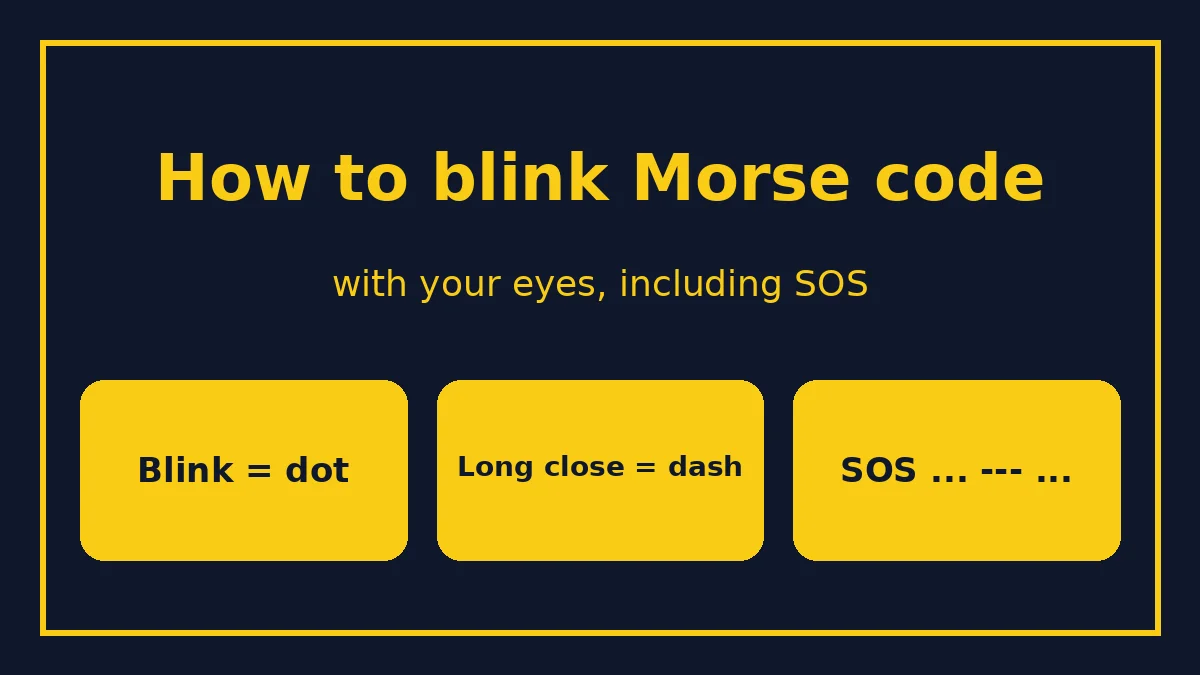
Blinking Morse code means sending dots and dashes with your eyes: a quick blink is a dot, a longer, deliberate close is a dash, and a pause separates letters. It is slow, but it works when you cannot speak, move your hands or make a sound. The most famous example is U.S. Navy Commander Jeremiah Denton, who blinked T-O-R-T-U-R-E during a filmed propaganda interview as a prisoner of war in 1966. This guide shows you how to blink Morse code, how to blink SOS, how to read someone else's blinks, and how to practise.
Use the Morse code translator to turn any word into dots and dashes before you try to blink it, and keep the Morse code chart open while you learn.
Can you blink in Morse code?
Yes. Morse code is just a rhythm of short and long signals, so anything you can switch on and off can carry it: a key, a buzzer, a flashlight, a tap on a pipe, or your eyelids. Blinking is the slowest of these because eyes tire quickly and normal blinks get in the way, but for a short word it works, and it can be done silently.
Three things make blinked Morse readable:
- Clear difference between dot and dash. A dash should be about three times as long as a dot.
- Pauses between letters. Keep your eyes open for a moment after each letter.
- A longer pause between words. Open, steady eyes for a few seconds.
Those ratios come from the international standard, which our ITU-R M.1677-1 guide explains in detail: a dash is three dots long, the gap between letters is three dots, and the gap between words is seven.
How to blink Morse code: step by step
- Pick a short word. Start with something like SOS, HI or YES.
- Look it up. Write the code on paper: HI is
.... ... - Set your dot length. A natural quick blink is your dot. Do not rush; a slightly slow blink is easier to read.
- Make dashes deliberate. Close your eyes and count "one-two-three" in your head, then open.
- Pause between letters. Keep your eyes open and still for about the same "one-two-three".
- Pause longer between words. Count to seven with your eyes open.
- Repeat the message. Anyone watching may miss the start. Send it two or three times.
Tip: a slight nod or a fixed stare before you start tells the watcher "message coming". In everyday blinking, your eyes close very quickly; in Morse you want controlled, exaggerated blinks.
How to blink SOS in Morse code
SOS is ... --- ..., which makes it the easiest distress message to blink:
- S: three quick blinks
- O: three long closes, about three counts each
- S: three quick blinks
- Pause with eyes open, then repeat
Because SOS is sent as one continuous pattern, do not leave long gaps between the letters. Keep it steady and repeat it. The SOS Morse code page has the audio and tap versions if you want to hear the rhythm first.
The Jeremiah Denton story
On July 18, 1965, Commander Jeremiah A. Denton Jr. was shot down over North Vietnam and captured. According to the U.S. National Archives, on May 2, 1966, his captors arranged a televised interview as part of a propaganda campaign. While speaking on camera, he blinked the word T-O-R-T-U-R-E in Morse code.
The National Archives says the videotape was later reviewed by U.S. Naval Intelligence, and Denton's one-word message was the first clear confirmation that American prisoners were being tortured. Denton later speculated that his captors did not learn about the blinking until 1974. He was released on February 12, 1973, retired from the Navy as a rear admiral and served in the U.S. Senate from 1981 to 1987.
Here is TORTURE in Morse, so you can see what he had to blink while answering questions:
| Letter | Morse |
|---|---|
| T | - |
| O | --- |
| R | .-. |
| T | - |
| U | ..- |
| R | .-. |
| E | . |
That is 15 signals, sent while talking calmly, with the camera on him. For more history of Morse in the armed forces, see military Morse code.
How to read someone else's blinks
Reading blinks is harder than sending them. Use this approach:
- Watch for the "message coming" signal, or simply a long stare followed by deliberate blinks.
- Write as you watch. Use a dot and a dash on paper, and a slash for every long pause.
- Do not decode in your head. Write the whole pattern first, then translate.
- Ask for a repeat. If you can, nod or blink back to show you are ready for the next send.
- Translate afterwards with the Morse code decoder or the chart.
If the blinks are on video, you can step through frame by frame. Our guide to decoding Morse code from an image explains how to count frames and turn a recording of flashes or blinks into dots and dashes.
Blinking vs light, tapping and sound
| Method | Speed | Silent? | Best for |
|---|---|---|---|
| Eye blinks | Slow | Yes | Short words face to face or on camera |
| Flashlight or lamp | Medium | Yes | Distance, at night |
| Tapping | Medium | No (quiet) | Through walls, pipes, a table |
| Sound (key or buzzer) | Fast | No | Radio, practice, long messages |
If you can use a light, it is faster and visible from much farther away; see light Morse code. If you can touch a surface, tapping is easier on the body; our Morse code tapping guide covers knock codes and timing. Want a machine that blinks for you? The Arduino Morse code project flashes an LED with any message you type.
Morse code as accessible communication
Morse is not just a survival trick. Because it needs only two signals, it can be operated with a single switch, a puff of air, or another small movement. In 2018 Google added Morse input to its Gboard keyboard, developed with Tania Finlayson, a Morse code and assistive technology developer who uses Morse to communicate. Android users can also connect external switches.
Researchers and assistive-technology developers have also built systems that detect eye blinks with a camera and convert them to Morse text. If you or someone you support needs this kind of communication long term, an augmentative and alternative communication (AAC) specialist or speech-language pathologist can recommend and set up the right tool.
How to practise blinking Morse code
- Start with your name. Look it up, write it down, and blink it in a mirror.
- Use a partner. One person blinks, the other writes down the dots and dashes. Swap roles.
- Record yourself. Film a few words on your phone and decode the video later.
- Learn the alphabet by sound first. It is much easier to blink letters you already know. The Morse code trainer and learn Morse code lessons help.
- Keep it short. Ten minutes is plenty; eyes tire fast.
- Rest your eyes. Stop if your eyes feel dry or sore, and blink normally for a while.
Common blinking mistakes
- Dots and dashes the same length. If the watcher cannot tell them apart, the message is lost. Exaggerate the dash.
- No gap between letters. Without a pause,
.-(A) and.-(E T) look identical. - Natural blinks sneaking in. Pause and blink normally before you start, so your eyes are comfortable.
- Going too fast. Slow, even blinks beat fast, messy ones every time.
Blink Morse code checklist
- Dot = quick, controlled blink
- Dash = deliberate close, about three times as long
- Eyes open for "one-two-three" between letters
- Eyes open for about seven counts between words
- Repeat the message two or three times
- Learn SOS first:
... --- ... - When reading, write first, decode afterwards
- Practise with a partner, a mirror or a phone video
Related reading
Morse light signals played a part in one of the most famous disasters at sea. Read our guide to Titanic Morse code to see how CQD and SOS were sent from the ship's wireless room, and how a Morse lamp on the bridge got no reply. For more ways to send messages quietly, see secret Morse code.
Sources
- U.S. National Archives, "Eyewitness: Comdr. Jeremiah A. Denton, Jr. - Report from Inside a Hanoi Prison, 1966"
- ITU-R M.1677-1, International Morse code (timing ratios)
- Google, "Making Morse code available to more people on Gboard" (July 2018)