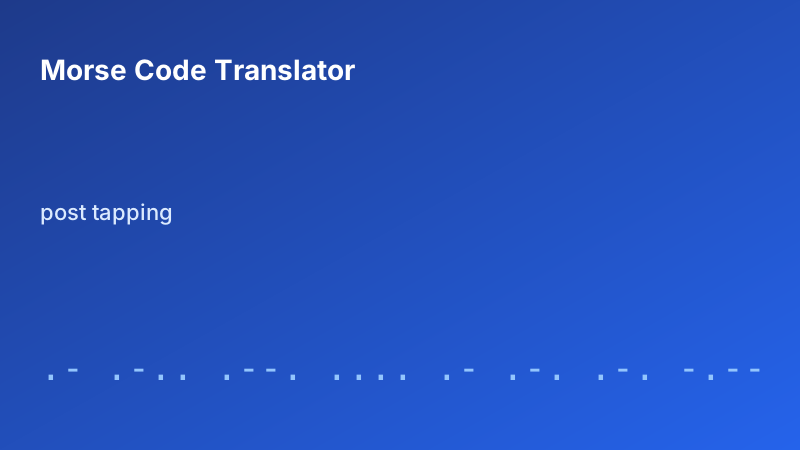
Long before radio microphones and smartphone keyboards, people communicated through walls, across prison yards, and across darkened rooms using nothing but rhythm. Tapping Morse code by hand is one of the oldest and most versatile transmission methods in the history of human signaling. Whether you want to send SOS in a survival situation, pass a secret message across a quiet classroom, or understand how Vietnam War prisoners communicated through concrete, this complete guide covers timing, technique, and practice methods you can start using today.
Why Tapping Morse Code Still Matters
Radio, satellite phones, and internet messaging dominate modern communication, yet manual tapping retains unique advantages. It requires no electricity, no equipment, and no license. A flashlight, a whistle, or a knuckle on a pipe can carry a Morse message when every other system fails. Tapping also teaches timing fundamentals that make you a better radio operator—understanding dot and dash proportions at the muscle level translates directly to cleaner keying on a telegraph paddle.
Historically, tapping saved lives. Allied prisoners in German Stalag camps during World War II developed elaborate tap networks. American POWs in Vietnam refined the five-by-five tap code that became legendary. Even today, survival instructors teach SOS tapping as a core outdoor skill alongside fire-starting and shelter building. Explore the broader context in our What Is Morse Code guide.
The Fundamentals of Morse Tapping Timing
Every Morse transmission—whether sent by radio, light, sound, or touch—follows the same timing ratios defined by the International Telecommunication Union. Master these proportions and your taps will be readable on any medium.
Dot and Dash Duration
- Dot (dit): One unit of time—the basic building block.
- Dash (dah): Three units of time—exactly three times longer than a dot.
- Space between elements within a letter: One unit (equal to one dot).
- Space between letters: Three units.
- Space between words: Seven units.
These ratios are documented in the International Morse Code specification on Wikipedia and remain unchanged since the nineteenth century. Absolute speed does not matter when tapping manually—your receiver adjusts to your tempo. What matters is maintaining the 1:3 ratio between dots and dashes and respecting the gaps between letters and words.
Practical Timing Example: The Letter A
The letter A in Morse is dot-dash (.-). To tap it correctly: one short tap, pause one beat, one long tap lasting three times as long. Then pause three beats before the next letter. Practice A, E (.), and T (-) first—they are the simplest shapes and appear in nearly every English word. Use our interactive alphabet chart to hear each letter's rhythm before you tap it.
Tapping Techniques for Different Situations
The surface, audience, and urgency determine which tapping method you choose. Each technique shares the same Morse timing rules but differs in execution.
Audible Table Tapping
The most common practice method. Use your index finger, knuckle, or a pen cap on a hard surface. Wood tables produce warm, carrying tones; metal surfaces ring louder and travel farther through walls and pipes. Start slowly—one second per dot—until the rhythm feels natural, then gradually increase speed. Record yourself on a phone and play it back through our Morse Code Translator decoder to check accuracy.
Silent and Covert Tapping
When sound would reveal your communication—during captivity, in a meeting, or in a shared dormitory—switch to silent tapping. Tap your finger lightly on your thigh, the side of a chair, or a notebook. The movement should be invisible to casual observers. Vietnam POWs tapped on cell walls using the tap code, a grid-based system that complemented Morse principles. Even a subtle long press versus short press on someone's hand can convey simple messages.
Pipe and Bulkhead Tapping
Ships, submarines, and industrial facilities use metal pipes and bulkheads as natural sound conductors. A tap on a pipe in one compartment can be heard rooms away. Naval traditions of pipe-tapping Morse persisted through the twentieth century. If you ever need to signal through a wall or floor in a building, identify the most resonant hard surface and tap firmly but not frantically—panic destroys timing.
Visual Blinking Morse
Although not technically tapping, blinking Morse follows identical timing. Short blinks are dots; long blinks (eyes closed roughly three times longer) are dashes. Jeremiah Denton, a U.S. Navy pilot captured in Vietnam, blinked the word TORTURE in Morse during a televised propaganda interview—a famous example of visual Morse saving lives. Practice blinking with our Light Morse Code tool, which demonstrates visual timing on screen. Full guide: how to blink Morse code with your eyes.
How to Tap SOS: The Essential Emergency Pattern
SOS (... --- ...) is the single most important pattern to memorize for tapping. It was chosen in 1908 not because it stands for "Save Our Souls" but because the rhythm—three short, three long, three short—is instantly recognizable even through noise and distortion.
Step-by-step SOS tapping:
- Three short taps (dots) with one beat between each.
- Pause three beats (letter gap).
- Three long taps (dashes), each three times longer than a dot, with one beat between each.
- Pause three beats.
- Three short taps again.
- Pause seven beats, then repeat the entire sequence.
Repeat SOS continuously until you receive a response. In survival scenarios, combine audible SOS tapping with whistle blasts or flashlight flashes using the same pattern. Read our dedicated SOS Morse Code guide for complete emergency signaling protocols.
The Vietnam War POW Tap Code
While not identical to International Morse Code, the tap code used by American prisoners of war in Vietnam deserves detailed explanation because it is the most famous tapping communication system in modern history.
How the 5×5 Tap Code Worked
Prisoners divided the alphabet into a five-by-five grid, combining C and K into one cell to fit 25 letters:
- Row 1: A B C/K D E
- Row 2: F G H I J
- Row 3: L M N O P
- Row 4: Q R S T U
- Row 5: V W X Y Z
To send a letter, tap the row number, pause briefly, then tap the column number. The letter G is row 2, column 2—two taps, pause, two taps. Messages spelled out word by word with longer pauses between words. The system was faster to learn than full Morse for prisoners with no prior training and no access to written reference materials.
Connection to Morse Timing Principles
Although the encoding differed, POWs relied on the same discipline Morse operators use: consistent rhythm, clear pauses, and repetition for confirmation. Commander James Stockdale and other senior prisoners organized tap networks that maintained morale, shared intelligence, and coordinated resistance. The ARRL and military historians have documented how these communication networks demonstrated that manual signaling remains viable when all electronic systems are denied.
Step-by-Step: Tapping Your First Message
Follow this progression to send your first complete tapped message within one practice session.
Phase 1: Single Characters (Day 1)
Learn and tap E (.), T (-), A (.-), and I (..). These four letters compose nearly 30 percent of written English. Tap each letter ten times, then randomize order. Have a partner listen and call out the letter they hear.
Phase 2: Two-Letter Words (Day 2–3)
Tap AT, IT, EA, TE, and AI. Focus on the three-beat gap between letters. Common mistake: running letters together. The gap is as important as the taps themselves.
Phase 3: Short Words (Day 4–7)
Progress to CAT, DOG, HELP, and WATER. Convert any word using our English to Morse Code converter, read the dot-dash pattern, then tap it slowly. Say the rhythm aloud—"di-dah-di-dah-di"—before tapping.
Phase 4: Full Sentences (Week 2+)
Tap "SOS WE NEED HELP" or "I AM OK" with proper seven-beat word spacing. Record audio and decode it yourself an hour later to test whether spacing held up under concentration fatigue.
Common Tapping Mistakes and How to Fix Them
Dashes too short: If your dashes are only twice the dot length, B ( -... ) sounds like a blur. Count "one-two-three" silently during every dash until muscle memory forms.
Insufficient letter gaps: Running "SOS" together as nine consecutive taps without pauses creates an unreadable jumble. The three-beat letter gap is non-negotiable.
Inconsistent force: Hard taps and soft taps on the same surface sound different. Maintain uniform pressure throughout a message.
Speed before accuracy: A clean 8 WPM message communicates; a sloppy 20 WPM message communicates nothing. Slow down until timing is perfect, then increase speed by small increments.
Skipping practice with a partner: Solo practice builds muscle memory, but only a listener reveals whether your gaps and dash lengths are actually readable. Practice with the Morse Code Trainer or a patient friend.
Advanced Tapping Applications
Survival and Wilderness Signaling
When lost outdoors, SOS tapping on a hollow log, metal equipment, or rock face may reach rescuers when voice shouts do not carry. Combine with three blasts on a whistle (same SOS rhythm) and visual signals. The emergency Morse guide covers multi-modal distress signaling in detail.
Accessibility Communication
Tapping Morse on a person's hand enables communication with deaf-blind individuals who know the code. Helen Keller communicated using finger-spelling and tactile methods; Morse on the palm extends this tradition for those trained in the system.
Educational Games for Children
Children learn tapping quickly because it feels like a secret code game. Start with SOS and their own name. Our Morse Code for Kids page provides age-appropriate activities that build timing skills through play.
Ham Radio Skill Building
Many CW operators practice tapping before picking up a key. Tapping isolates timing from radio technique, letting you focus purely on rhythm. When you transition to a paddle or straight key, your fist—the distinctive rhythm of your sending—will be cleaner because your internal clock already works.
Practice Drills for Daily Improvement
Spend fifteen minutes daily on structured tapping drills:
- 5 minutes: Random character tapping—have a partner call out letters, you tap them.
- 5 minutes: Copy tapping—partner taps, you write the letter. Switch roles.
- 5 minutes: Message tapping—encode a short phrase with the translator, tap it, verify by decoding the recording.
Weekly, test yourself with the Morse Code Quiz to ensure auditory recognition keeps pace with your sending skill.
Tapping vs. Other Manual Morse Methods
Tapping is one of several manual transmission methods. Choosing the right one depends on environment:
- Tapping — Best through walls, pipes, and in silence-required situations.
- Whistle or horn — Best outdoors over distance; same SOS timing applies.
- Flashlight — Best at night for aircraft or ship signaling; see our light tool.
- Flag semaphore — Different system entirely; uses arm positions, not Morse timing.
- Mirror heliograph — Uses reflected sunlight with Morse on/off flashes for long-distance daytime signaling.
If you want hardware instead of fingers, our Morse code key guide compares straight keys and paddles.
Frequently Asked Questions
How do you tap Morse code with your fingers?
Use short taps for dots and long taps for dashes. A dash should last roughly three times as long as a dot, with one dot-length pause between symbols in the same letter, three dot-lengths between letters, and seven dot-lengths between words.
What is the POW tap code?
The Vietnam War tap code was a 5×5 letter grid (excluding K, which was represented as C). Prisoners tapped two numbers—row then column—to spell messages through walls. It was inspired by Morse timing principles but used a different encoding system for speed and simplicity.
Can you tap SOS in Morse code?
Yes. SOS is three short taps, three long taps, three short taps (... --- ...). It is the most recognizable Morse pattern in the world and works on any surface—walls, pipes, tables, or railings.
How long should a dash be when tapping?
A dash should be approximately three times the duration of a dot. If your dot is one second, your dash is three seconds. Consistent ratio matters more than absolute timing—your receiver can adapt as long as the proportions stay correct.
Can Morse code be tapped silently?
Yes. Silent tapping uses subtle finger or pen taps on a desk, leg, or armrest. Prisoners of war, students, and people in meetings have used imperceptible taps to communicate without sound. Visual blinking follows the same long/short timing principle.
What surface is best for tapping Morse code?
Hard, resonant surfaces like wooden tables, metal pipes, or ship bulkheads carry sound farthest. For silent communication, any surface that absorbs impact without echo works—your thigh, a notebook, or a chair arm.
Grab a pen, find a table, and tap out SOS three times. Then open our free Morse Code Translator, type any message, and practice matching the audio rhythm with your fingers. Every expert tapper started with a single dot.