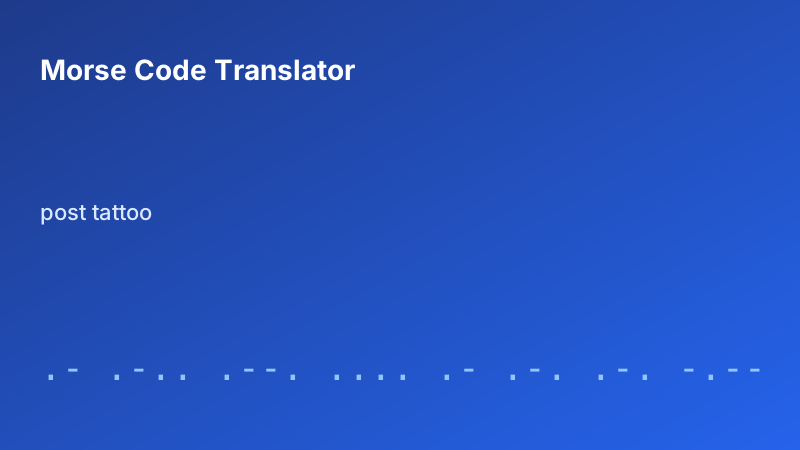
Morse code tattoos offer a uniquely personal way to carry meaningful messages on your skin — secret words, names, dates, and coordinates encoded in dots and dashes that hold deep significance for you while appearing as elegant minimalist art to everyone else. Whether you are considering your first tattoo or adding to an existing collection, this guide covers popular designs, placement strategies, verification steps, and everything you need to ensure your Morse code ink is accurate, beautiful, and permanent in all the right ways.
Why Morse Code Tattoos Have Become So Popular
In an era of bold script quotes and oversized portrait tattoos, Morse code designs stand apart through restraint and secrecy. A line of dots and dashes running along a forearm or wrist looks like abstract geometric art to the untrained eye — but to the wearer, it spells a name, a promise, a date, or a place that changed their life. This duality of public art and private meaning drives the enduring appeal of Morse code body art.
The aesthetic aligns perfectly with current tattoo trends favoring fine lines, minimalist compositions, and negative-space designs. Morse code tattoos require no elaborate imagery — the power lies entirely in the encoded message and the wearer's connection to it. As the Wikipedia entry on Morse code notes, this encoding system has communicated life-or-death messages, love letters across continents, and emergency distress signals for nearly two centuries — giving Morse tattoos a weight of history that random symbols cannot match.
Amateur radio operators and military veterans have worn Morse-related ink for decades, often encoding call signs or unit mottos. The design has since entered mainstream tattoo culture, with celebrities and influencers showcasing Morse code pieces that encode everything from children's birthdays to motivational single words. The American Radio Relay League community continues to inspire designs rooted in radio culture, while the broader tattoo world has adapted the format for purely personal expression.
Popular Morse Code Tattoo Messages
Choosing your message is the most important decision in the tattoo process. Here are the most commonly requested phrases, with their verified International Morse Code patterns.
Single-Word Tattoos
Single words dominate Morse code tattoo designs because they fit comfortably on fingers, wrists, and small placements. They also carry clear, powerful meaning without requiring extensive linear space.
- STRENGTH — ... - .-. . -. --. - ....
- HOPE — .... --- .--. .
- LOVE — .-.. --- ...- .
- FAITH — ..-. .- .. - ....
- BRAVE — -... .-. .- ...- .
- DREAM — -.. .-. . .- --
- PEACE — .--. . .- -.-. .
- WARRIOR — .-- .- .-. .-. .. --- .-.
Phrase Tattoos
Longer messages require more skin real estate but allow richer storytelling. Popular multi-word phrases include:
- I LOVE YOU — .. / .-.. --- ...- . / -.-- --- ..-
- THIS TOO SHALL PASS — - .... .. ... / - --- --- / ... .... .- .-.. .-.. / .--. .- ... ...
- STAY STRONG — ... - .- -.-- / ... - .-. --- -. --.
- NEVER GIVE UP — -. . ...- . .-. / --. .. ...- . / ..- .--.
- ALWAYS AND FOREVER — .- .-.. .-- .- -.-- ... / .- -. -.. / ..-. --- .-. . ...- . .-.
Explore our full Phrases in Morse Code library for audio playback and additional inspiration across romantic, motivational, and memorial categories.
Names and Initials
Encoding a loved one's name is one of the most requested Morse tattoo designs. A child's first name on a parent's wrist, a partner's initials on a finger band, or a deceased family member's full name on the ribcage — each carries intensely personal weight. Look up each letter on the Morse Code Alphabet chart or type the name into the Morse Code Translator to generate the exact pattern your artist needs.
Coordinates and Dates
Geographic coordinates of a birthplace, wedding venue, or favorite travel destination encode into numeric Morse patterns that look elegantly abstract. Dates — anniversaries, birth dates, memorial dates — work similarly. A wedding date like 06-15-2024 becomes --.... / .---- ..... / ..--- ----- ..--- .... in Morse, creating a design that is meaningless to observers but instantly recognizable to the wearer.
Memorial and Tribute Tattoos
Morse code excels as a memorial format because it encodes tribute messages with dignity and privacy. "Forever remembered," a loved one's dates of birth and passing, or simply their name encoded in dots and dashes creates a permanent connection without the visual heaviness of portrait tattoos or overtly mournful imagery. Many people combine Morse code with small symbolic elements — a heartbeat line transitioning into dots and dashes, or a bird silhouette above the encoded message.
Tattoo Placement Guide
Placement affects both the visual impact and the practical constraints of your Morse code tattoo. Linear dot-dash sequences need relatively flat skin with enough length to maintain readable spacing.
Forearm (Inner and Outer)
The most popular placement for Morse code tattoos. The inner forearm offers a flat canvas 20–25 cm long — enough for most phrases. Outer forearm placements work well for longer messages and pair naturally with existing sleeve work. Visibility is moderate: easy to show or conceal with long sleeves.
Wrist and Inner Arm
Ideal for short messages — a single word, initials, or a date. The inner wrist is highly visible during daily activities, making it a constant personal reminder. Keep messages to four to eight characters at this size to prevent dots from blurring together over time.
Collarbone and Chest
Collarbone placements create an elegant horizontal line visible with open-neck clothing. Chest placements over the heart carry symbolic weight for memorial and love-themed messages. Both areas accommodate medium-length phrases with comfortable spacing.
Finger Bands
A dot-dash sequence wrapping around a finger is one of the most discreet Morse tattoo options. Limit finger tattoos to three to five characters — a short word like "LOVE" or three initials. Finger skin regenerates faster than other areas, so touch-ups may be needed more frequently.
Behind the Ear
Ultra-discreet placement for short codes — initials, a single letter, or a two-character word. Hidden by hair in professional settings but easily shown to those who matter. The small area demands precise work from an experienced fine-line artist.
Ribcage and Side Body
Private placements for longer, deeply personal messages. The ribcage accommodates full phrases and coordinates with ample space. Pain level is higher in this area, but the intimacy of the placement matches the secrecy of the encoded message.
Spine and Back of Neck
Vertical Morse sequences running along the spine create striking visual compositions. The back of the neck suits short codes visible only when hair is worn up. Both placements offer privacy and dramatic reveal.
Design Styles and Visual Approaches
How dots and dashes are rendered artistically defines the tattoo's overall aesthetic. Consider these popular styles when consulting with your artist.
Classic Dot-Dash Line
The purest form: small solid dots and horizontal dash lines arranged in Morse sequence with proper letter and word spacing. Usually rendered in black fine-line ink. Clean, timeless, and immediately readable to anyone who knows Morse code.
Geometric and Minimalist
Dots as tiny circles and dashes as short parallel lines, sometimes with deliberate geometric spacing that emphasizes the pattern's visual rhythm over strict readability. This style prioritizes aesthetics while maintaining accurate encoding.
Watercolor and Mixed Media
Black dot-dash sequences overlaid on soft watercolor washes — blues, purples, or sunset tones — create contrast between the structured code and organic color. Watercolor backgrounds fade gracefully over time while the Morse pattern remains crisp in black ink.
Integrated Symbolism
Morse code combined with complementary imagery: a heartbeat EKG line that transitions into the encoded message, a tree whose branches form dot-dash patterns, or an arrow where the shaft is rendered in Morse. These designs layer personal meaning through both the encoded text and the surrounding visual metaphor.
Typewriter and Serif Font Styles
Some artists render Morse using typographic dots and dashes — the dot as a period character and the dash as an underscore or hyphen in a monospace font. This approach creates a literary aesthetic that appeals to writers, editors, and book lovers.
Size and Spacing Specifications
Proper sizing ensures your Morse code tattoo remains readable for decades. Follow these guidelines when discussing dimensions with your artist.
Minimum dot diameter: 3 mm. Smaller dots blur into unrecognizable spots within a few years as ink spreads slightly under the skin. Dashes should be at least 8–10 mm long and roughly three times the dot diameter, matching standard Morse timing ratios.
Letter spacing: Leave a gap equal to one dot diameter between characters within a word. Without this gap, adjacent letters merge visually and become impossible to decode.
Word spacing: Use a gap three times the dot diameter, or insert a small symbolic separator — a star, heart, or vertical line — between words. This is especially important for multi-word phrases.
Overall length estimate: A single word averaging five letters requires approximately 8–12 cm at proper sizing. The phrase "I LOVE YOU" needs 15–20 cm. Use the translator to count total symbols and estimate length before your consultation.
How to Verify Your Translation Before Getting Inked
A Morse code tattoo mistake is permanent. Unlike jewelry that can be restrung or remade, incorrect ink requires painful and expensive laser removal. Follow this verification protocol without skipping any step.
Step 1: Generate the Official Pattern
Type your exact message — including punctuation and spacing — into the Morse Code Translator. Screenshot or print the complete dot-dash output. This is your reference document.
Step 2: Character-by-Character Check
Open the Morse Code Alphabet chart and verify every single character in your message. Pay special attention to easily confused pairs: the letter B (-...) versus the number 6 (-....), the letter U (..-) versus the number 4 (....-), and the letter G (--.) versus the letter W (.--).
Step 3: Count Dots and Dashes
Total the number of dots and dashes in the translator output. Count the dots and dashes in your artist's stencil. These numbers must match exactly.
Step 4: Verify Spacing
Confirm letter gaps and word gaps are marked on the stencil. A missing word-space separator turns "I LOVE YOU" into an unreadable string of letters without boundaries.
Step 5: Second-Person Review
Ask someone else to independently decode the stencil using the alphabet chart. If they arrive at a different message than intended, find the discrepancy before proceeding.
Step 6: Final Stencil Approval
At the tattoo session, inspect the applied stencil on your skin. Read the pattern one more time against your reference document. Only then give the artist permission to begin tattooing.
Working With Your Tattoo Artist
Not every tattoo artist has experience with Morse code designs. Provide your verified pattern document at the consultation — do not rely on the artist to translate English to Morse independently. Translation errors by artists who guess at the code are surprisingly common.
Request a fine-line specialist for Morse code work. The precision required for readable dots and consistent dash lengths demands steady hand technique and experience with minimalist designs. Ask to see portfolio examples of previous dot-work or geometric tattoos.
Discuss aging during the consultation. Fine dots on fingers and hands may require touch-ups every five to seven years. Forearm and upper arm placements hold up significantly longer. Your artist should size dots conservatively to account for natural ink spread over time.
Morse Code Tattoo Ideas by Theme
Couples and Matching Tattoos
Partners often get complementary Morse tattoos — one wears "I LOVE YOU" and the other wears the encoded response, or each wears one half of a shared coordinate where they met. Matching finger bands with each partner's initials in Morse are a popular minimalist choice.
Family and Parent Tattoos
Parents frequently encode children's names, birth dates, or birth times in Morse code. A mother might wear her child's name on her inner wrist; a father might encode his children's initials on his forearm separated by word-spacing markers. Sibling sets sometimes share matching designs with each person's name encoded individually.
Military and Service Tattoos
Service members and veterans encode unit mottos, deployment dates, coordinates of significant locations, or the names of fallen comrades. Morse code resonates strongly in military culture because it remains a backup communication method taught in many service branches. The U.S. Navy reintroduced Morse training in 2022, reflecting its continued relevance.
Recovery and Motivational Tattoos
Words like STRENGTH, HOPE, BREATHE, and WARRIOR serve as daily reminders for people in recovery from illness, addiction, or trauma. The hidden nature of Morse encoding adds a layer of personal privacy — the message supports the wearer without advertising their journey to the world.
Ham Radio Operator Tattoos
Amateur radio enthusiasts often tattoo their call signs in Morse code — a tradition rooted in the radio community's deep connection to CW operation. Some operators encode QSO counts, DX achievements, or the Morse prosign for "best regards" (73). Test your call sign encoding with the Morse Code Trainer before committing it to ink.
Aftercare for Morse Code Tattoos
Fine-line Morse tattoos require standard aftercare with extra attention to dot areas. Keep the tattoo clean and moisturized during the two-to-three-week healing period. Avoid soaking in pools or baths. Apply SPF 30+ sunscreen once healed to prevent fading, especially on forearms and wrists that receive daily sun exposure.
Schedule a touch-up consultation six months after healing if any dots appear to have lost definition. Minor touch-ups are normal for fine-line work and are typically included in the original session price at reputable studios.
Test Your Knowledge Before You Ink
Before finalizing your design, test whether you can read Morse code yourself. Take the Morse Code Quiz to build basic recognition skills — understanding the code your tattoo speaks deepens your connection to the ink. Practice decoding your chosen message using the trainer until you can read it by sound without reference materials.
There is something profoundly satisfying about wearing a message you can decode yourself — a secret written on your skin in a language you took the time to learn. Whether your tattoo encodes a name, a promise, a place, or a single word that defines your journey, the process of choosing, verifying, and finally wearing your Morse code ink creates a bond between message and wearer that no other tattoo style can replicate.
Want to check a tattoo design? See how to decode Morse code in a photo.
Frequently Asked Questions
What are the most popular Morse code tattoo phrases?
STRENGTH, HOPE, LOVE, ALWAYS, and I LOVE YOU are the most commonly tattooed Morse phrases. Coordinates of meaningful locations, children's names, wedding dates, and memorial dates are also extremely popular. See our phrases collection for more ideas.
Where is the best placement for a Morse code tattoo?
The forearm, inner wrist, and collarbone are the most popular placements because they offer enough linear space for dot-dash sequences. Finger bands, behind the ear, and ribcage placements work well for shorter messages. Choose a flat area where the artist can maintain consistent dot and dash spacing.
How do I verify my Morse code tattoo before getting inked?
Type your exact message into the Morse Code Translator, screenshot the output, and compare every character against the alphabet chart. Have your tattoo artist stencil the design and verify it again before any ink touches skin. Tattoos are permanent — triple-check spacing and character accuracy.
What size should a Morse code tattoo be?
Allow at least 3–4 mm per dot and 8–10 mm per dash for readability. A single word like STRENGTH needs roughly 8–12 cm of linear space. Shorter messages fit on fingers and behind the ear; longer phrases require forearms, ribs, or upper arms.
Can Morse code tattoos use colors?
Yes. Many designs use two ink colors — one for dots and one for dashes — or incorporate watercolor backgrounds behind minimalist dot-dash lines. Black ink remains the most popular choice for longevity and clarity, especially for fine-line work.
Do Morse code tattoos fade differently than regular text tattoos?
Fine dots may blur slightly over time, which is why experienced artists recommend sizing dots no smaller than 3 mm and using adequate spacing between elements. Dashes hold up better because of their larger surface area. Follow standard tattoo aftercare and touch up dots if needed after several years.