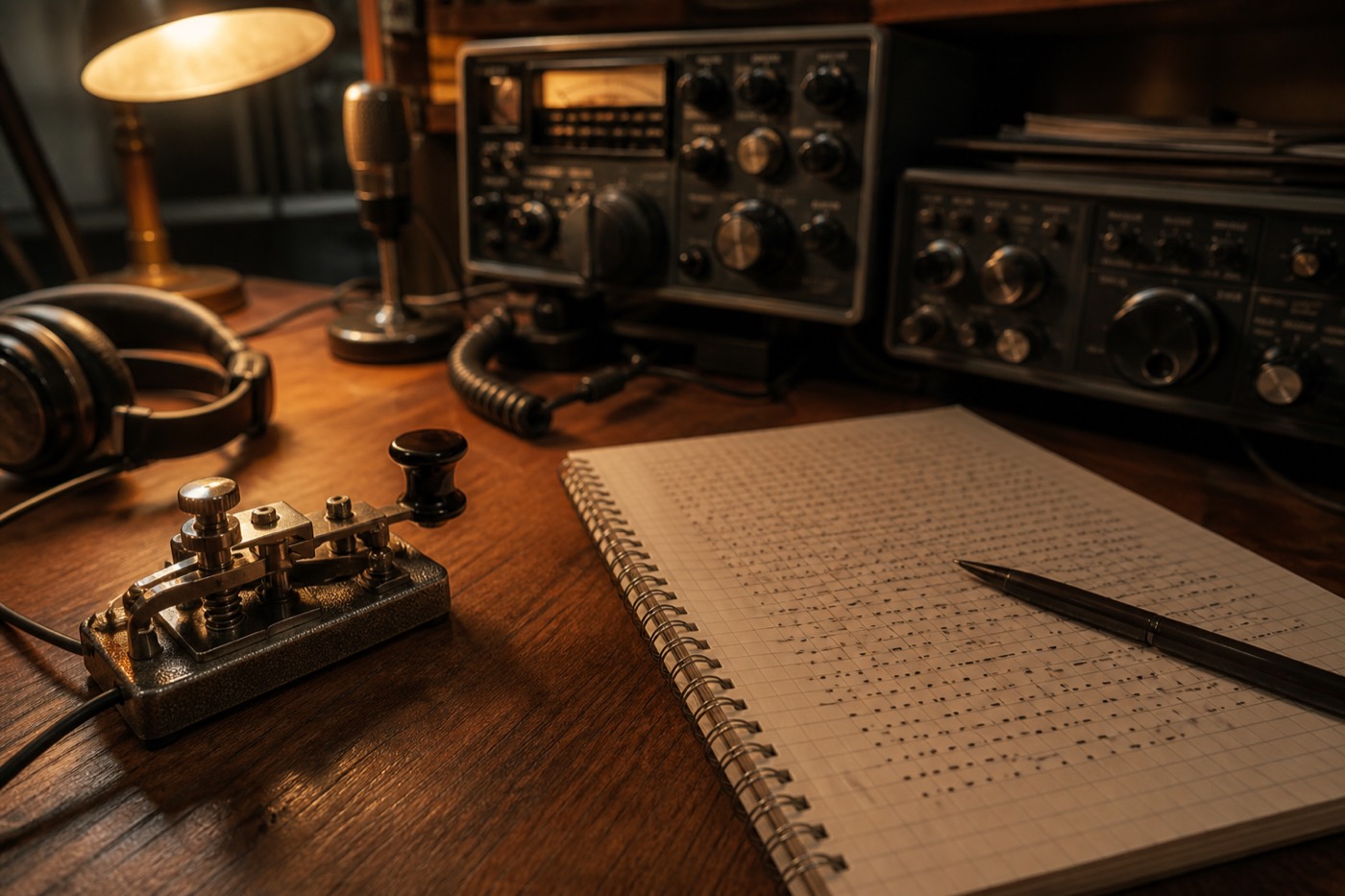
A cw translator is what operators reach for when they need English out of a string of dits and dahs, or a clean sidetone out of a call sign. CW is the ham-radio name for Morse sent as a continuous-wave carrier keyed on and off. It is not a secret code, not a puzzle font, and not a third alphabet hiding behind International Morse. This guide explains how a ham radio CW translator should behave, how Morse to English CW decode actually fails, and how ITU Morse timing is the product — then points you at the free tool on the homepage so you can check copy without pretending a browser replaces a radio.
CW Means Continuous Wave, Not “Covert Writing”
Amateur operators say CW the way a carpenter says grain. The mode is Morse. The physics is a narrow on/off tone. When someone searches CW Morse they are usually looking for that radio habit: call signs, RST, QTH, 73, and the timing that makes those groups copyable through noise. They are not looking for a spy cipher. Morse was designed to be read. A cw translator that markets itself as encryption is misusing the word.
International Morse, coordinated in ITU recommendations, is the living standard on HF amateur bands, in most classrooms, and in the practice audio on this site. American (railroad) Morse is a historical landline variant with spaced dots inside some letters. Do not mix the two. If a ham radio CW translator silently uses railroad Morse, your QSO copy will disagree with every modern chart. Ours does not. Every beep follows International Morse.
The other confusion is binary. CW is not a fixed-width packet. Silence is data. Letter gaps and word gaps are as meaningful as the marks. A translator that concatenates every dit into one blob cannot recover English any more than a reader can parse a sentence with no spaces. That is why Morse to English CW is a spacing problem first and a lookup-table problem second.
If you are new to the mode, pair this article with Learn Morse Code and the HAM radio Morse overview. Charts belong on the wall. Ears belong on the radio. The translator sits between them as a referee.
What a CW Translator Should Do (And Refuse to Fake)
A honest cw translator has three jobs. It encodes English into Morse text and timed audio. It decodes Morse text into English. It preserves ITU Morse timing so a dah is three dits long and the silences keep their ratios. It should not invent prosigns you did not send, guess at missing letter spaces, or “correct” a sloppy log into a sentence you never copied.
Ham radio traffic is not literary English. Contest exchanges, cut numbers, and Q-codes will decode as letters, not as a novel. A ham radio CW translator that prints “location” when you pasted QTH is editorializing. Print QTH. Let the operator interpret. The same rule applies to AR, SK, and BT: they are procedural, not vocabulary.
Speed controls matter because CW is a rhythm skill. Character speed in words per minute should stay high enough that E and T still sound like themselves, while extra Farnsworth space between letters keeps the overall pace humane. A translator that only slows the dits inside a letter trains a counting habit that collapses on a real pileup. Keep characters fast. Add space between them. That is the same advice as the Farnsworth spacing page, applied to a translator instead of a lecture.
Tone frequency is comfort, not magic. Most people copy in a few hundred hertz range that does not fatigue the ear. Pick a pitch you can stand for fifteen minutes. Then leave it alone so your brain is not relearning the instrument every session.
Morse to English CW: Decode Without Wishful Spacing
The query Morse to English CW is the receive direction: marks in, letters out. Paste ... --- ... and you should see SOS. Paste a run of dots with no letter gaps and you should see failure, not a lucky guess. Gaps are the delimiter. Morse is not self-describing the way UTF-8 is.
A correct Morse to English CW pass normalizes . and - (and often * and _) into dits and dahs, splits on word separators, splits on single spaces between letters, looks up each token in the International table, and joins the letters. Unknown tokens should stay as question marks. A translator that silently drops a bad group is hiding your copy error.
Practice with groups you will actually send. CQ is -.-. --.-. DE is -.. .. Your call sign should round-trip: English to Morse to English with the same letters. If Morse to English CW returns a different call, you dropped a space or used the wrong Morse family. Check the alphabet chart and the numbers guide for five-element digits. Grid squares and signal reports are where number errors show up first.
When the source is a paper log, type what is on the page, including the slashes you used as word breaks. Do not “help” the cw translator by removing spaces you think look ugly. Those spaces are the message. If the log used American Morse, no International tool will rescue it. Identify the era before you blame the software.
ITU Morse Timing Is the Difference Between CW and a Font
ITU Morse timing is the reason a ham radio CW translator must play audio, not only print dots. A dah lasts three dits. Intra-letter silence lasts one dit. Inter-letter silence lasts three. Inter-word silence lasts seven. If you memorize a poster and tap with even gaps, you are sending a visual code that good operators will not copy as Morse.
The homepage CW translator is built so generation and decode share one table and one clock. Generate TEST. Listen. Cover the English. Copy. Decode your paper. That loop is how a translator earns its keep. Generating a paragraph you never listen to is typesetting.
On the air, timing errors are louder than alphabet errors. A rushed letter gap turns ET into A. A stretched intra-letter gap turns A into ET. Record yourself and decode the recording as Morse to English CW. If the machine prints a different word than you intended, your spaces moved. Keep sessions short so you do not engrave the mistake.
Prosigns are sent as one glued character. AR is not the letters A and R with a letter space; it is a run of dits and dahs with no internal letter gap. A cw translator may print AR as two letters if you inserted a space. Learn the difference on the prosigns page before you paste a contest log and wonder why the English looks like alphabet soup.
How to Practice With a Ham Radio CW Translator (No Fake Speed Claims)
Fifteen minutes with a closed loop beats an hour of staring at a chart. Type SOS, CQ, your call, TEST, and 73. Play each. Hide the English, copy by ear, and grade yourself. Then paste yesterday’s notebook Morse and run Morse to English CW so spacing errors cannot fossilize. Add Q-codes from the Q-code sheet once letters are stable. Decode them as letters, then say the meaning out loud.
Do not chase a words-per-minute number from a forum. Chase clean spaces at a character speed you can hear as shapes. Then reduce Farnsworth gaps. A ham radio CW translator that offers a fast button is not a license to skip the middle.
When you are ready for a key, send what you have already heard. Never send Morse you have only seen as printed dots. The radio puts that rhythm into a filter and a pileup. Those are different rooms.
CW Is Still Used — And Still Public
CW remains a daily amateur mode because a narrow keyed signal can be copied when voice cannot. That is physics, not nostalgia. It is also why a cw translator is a learning aid and a log checker, not a decoder ring. Anyone can read International Morse. If you need privacy, Morse is the wrong tool. If you need a backup mode, Morse is still the right one.
Military and maritime history used Morse as a standard, not as a riddle. SOS is famous because the pattern is easy to recognize. Treat CW Morse the same way: public alphabet, strict timing, operational abbreviations.
Keep returning to the homepage translator when you need a cw translator burst, a Morse to English CW check, or a timing sanity test. Use the trainer for random groups. Morse is a language of time, not a lock. Dots and dashes still speak in public — only as honest as the gaps you fed the machine.