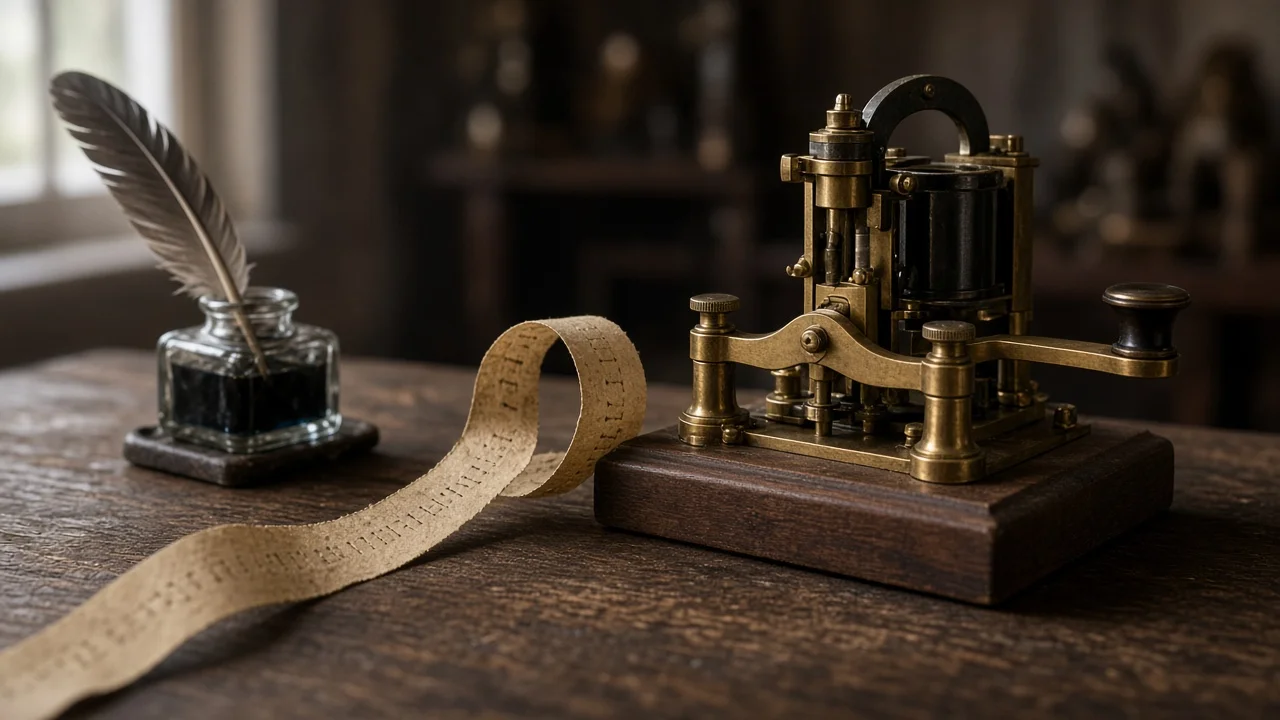
The first Morse code message most people mean is "What hath God wrought," sent by Samuel F. B. Morse on May 24, 1844, over an experimental telegraph line from the U.S. Capitol in Washington, D.C., to his partner Alfred Vail in Baltimore. It was not the first time Morse and Vail had sent a coded signal, but it was the official public opening of the first long-distance telegraph line in the United States, and the paper tape from that day still survives.
This guide walks through what happened that day, the earlier test messages that came before it, what the original tape actually looks like, and how to write the famous words in the International Morse code you can use today. If you want to try it as you read, paste the phrase into the Morse code translator and play the audio.
The short answer: what was the first Morse code message?
The famous first message was the question-like phrase "What hath God wrought?" It is a line from the Bible, Numbers 23:23. According to the Library of Congress, Morse sent it from the Supreme Court chamber in the U.S. Capitol to Vail, who was waiting at a Baltimore & Ohio Railroad depot in Baltimore. Vail sent the same words back, which proved the line worked in both directions.
The phrase was not Morse's own choice. The Library of Congress and the U.S. Senate's history office both credit Annie Ellsworth, the young daughter of Patent Commissioner Henry Leavitt Ellsworth, with picking the verse. Morse later wrote a note across the top of the tape crediting her.
So when someone asks "what was the first Morse code message," there are really two answers:
- The first official long-distance message: "What hath God wrought," May 24, 1844, Washington to Baltimore.
- The first public demonstration message: "A patient waiter is no loser," sent in January 1838 at Speedwell Ironworks in Morristown, New Jersey, over about two miles of wire looped inside a building.
Both are real, and both are worth knowing. The 1844 message gets the fame because it opened a working line between two cities.
How the 1844 line came to exist
Morse had been demonstrating his electromagnetic telegraph for years before 1844, but he needed money to prove it could work across real distance.
The 1838 tests
In January 1838, Morse and Vail showed their system at the Speedwell Ironworks, owned by Alfred Vail's father, Stephen Vail. The IEEE's Engineering and Technology History Wiki records that the message "A patient waiter is no loser" was sent through two miles of wire. At that stage the system did not spell words letter by letter the way modern Morse does. It sent numbers, and each number pointed to a word in a code dictionary.
A month later, according to the U.S. Senate's account, Morse set up his equipment in the room of the House Committee on Commerce in the Capitol and demonstrated it for members of Congress and President Martin Van Buren.
The $30,000 appropriation
Interest did not turn into funding right away. The Senate history page explains that Congress took no action for several years, partly because of the Panic of 1837. Morse kept pushing, and in 1843 Congress approved $30,000 to build a test line "of such length, and between such points, as shall fully test its practicability and utility." The bill was signed into law on March 3, 1843, the last day of that Congress.
Morse and his team chose Baltimore as the far end and ran the wire along the route of the Baltimore & Ohio Railroad. The Smithsonian's National Museum of American History describes it as a forty-mile line, completed in May 1844.
A preview on May 1, 1844
Before the official opening, the partly finished line already carried real news. Reporting based on the U.S. House historian notes that on May 1, 1844, word of the Whig Party's nomination of Henry Clay was sent from the convention in Baltimore toward Washington. That made the line useful before it was formally opened, and it helped build public interest in the May 24 demonstration.
May 24, 1844: what happened in the room
On May 24, Morse sat at his instrument in the old Supreme Court chamber in the Capitol, with a small group of guests watching. Annie Ellsworth's chosen words were sent down the line. In Baltimore, Vail's receiver marked the signal on a moving strip of paper. Then Vail sent the same message back.
The Senate's history office says the identical message came back from Baltimore "moments later," which is what made the experiment a clear success. Nobody had to take Morse's word for it. The guests could see a message leave Washington and see it return.
Why a Bible verse?
Annie Ellsworth chose the verse, and Morse sent it. The line comes from Numbers 23:23 in the King James Version. For your own practice, the reason matters less than the result: a short, memorable phrase that people still recognize nearly two centuries later.
Was it a question or an exclamation?
You will see it written both ways. The Library of Congress titles its record with a question mark, "What hath God Wrought?", while some news retellings use an exclamation point. The tape itself is a string of marks, not printed punctuation, so the question mark versus exclamation point debate comes from how people transcribed and quoted it later. Either way, the words are the same.
What the original tape looks like
The Library of Congress holds Morse's outgoing tape from Washington. Its catalog record explains several details that surprise most readers.
- The marks were embossed, not printed. Morse's early receiver pressed raised dots and dashes into a paper strip. An operator then read them and wrote out the words.
- Annie Ellsworth traced the letters. Morse wrote the letters in pencil under each code character, and Annie later traced over them in pen and ink.
- There were four tapes. The Library of Congress lists the outgoing tape from Washington, the incoming tape in Baltimore, Vail's outgoing repeat-back tape, and the tape that recorded the repeat-back in Washington. It says the whereabouts of all but one, Vail's outgoing strip, are known.
- It came to the Library in 1922. Annie Ellsworth's daughter, Mrs. George Inness, gave the tape to the Library of Congress.
The Smithsonian has a related object: a tape dated May 25, 1844, a souvenir message sent by Vail to Morse the day after the opening. Morse's son Edward donated it in 1900.
You can view both online, and they make an excellent primary source for a history lesson or a school project. If you are studying the broader timeline, the Morse code history page covers the years before and after this moment.
What hath God wrought in Morse code
Here is the phrase in modern International Morse code. Letters are separated by spaces and words by a slash.
| Word | International Morse |
|---|---|
| WHAT | .-- .... .- - |
| HATH | .... .- - .... |
| GOD | --. --- -.. |
| WROUGHT | .-- .-. --- ..- --. .... - |
All together:
.-- .... .- - / .... .- - .... / --. --- -.. / .-- .-. --- ..- --. .... -
For the 1838 test message, "A patient waiter is no loser":
.- / .--. .- - .. . -. - / .-- .- .. - . .-. / .. ... / -. --- / .-.. --- ... . .-.
One important caution: the 1844 code was not today's Morse
The code on the 1844 tape is the original American Morse, sometimes called railroad Morse. It is not the International Morse code above. Several letters were different, and American Morse used extra spacing inside some characters, which International Morse dropped. If you try to read the historic tape with a modern chart, some letters will not match. The International vs American Morse code guide explains the differences in plain terms.
So the table above shows how you would send the phrase today, not a copy of what Morse keyed in 1844.
How to send and practice the phrase yourself
"What hath God wrought" is a good practice line. It is short, it mixes long and short letters, and it repeats sounds such as H, A, and T.
- Read it first. Look at the code table and say the rhythm aloud: "dit-dah-dah, dit-dit-dit-dit, dit-dah, dah."
- Listen to it. Type the phrase into the translator and play it at a slow speed. Pay attention to the gaps between letters and words.
- Tap it. Use a desk, a pen, or the on-screen Morse keyboard to tap each letter. Keep dahs about three times as long as dits.
- Check your spacing. The most common beginner mistake is running letters together. The timing and WPM guide shows the standard gaps.
- Try copying it by ear. Have a friend or the audio player send it while you write the letters down without looking.
If any letter feels slippery, check it against the Morse code alphabet chart. G, R, and U are the ones beginners mix up most in this phrase.
Why this message still matters
The 1844 demonstration showed that messages could cross a long distance almost instantly, which changed how news, business, and governments worked. By October 1861, telegraph wires linked the East and West Coasts, and Morse-based signaling went on to play a large role in railroads, shipping, and war.
Later chapters of that story include the Titanic's distress messages in 1912 and the heavy use of radio Morse during World War II. Each one built on the simple idea that was proven on May 24, 1844: pulses of electricity, arranged in a code, can carry human language.
Using the message in class
Teachers often use the first telegraph message as a primary source activity. A simple plan:
- Show students the Library of Congress image of the tape.
- Ask them what they notice: the embossed marks, the handwriting, the note at the top.
- Have them encode the phrase in International Morse and compare it with the original.
- Discuss why the two versions do not match, which leads into American versus International Morse.
It works for middle school and up, and it takes about one class period.