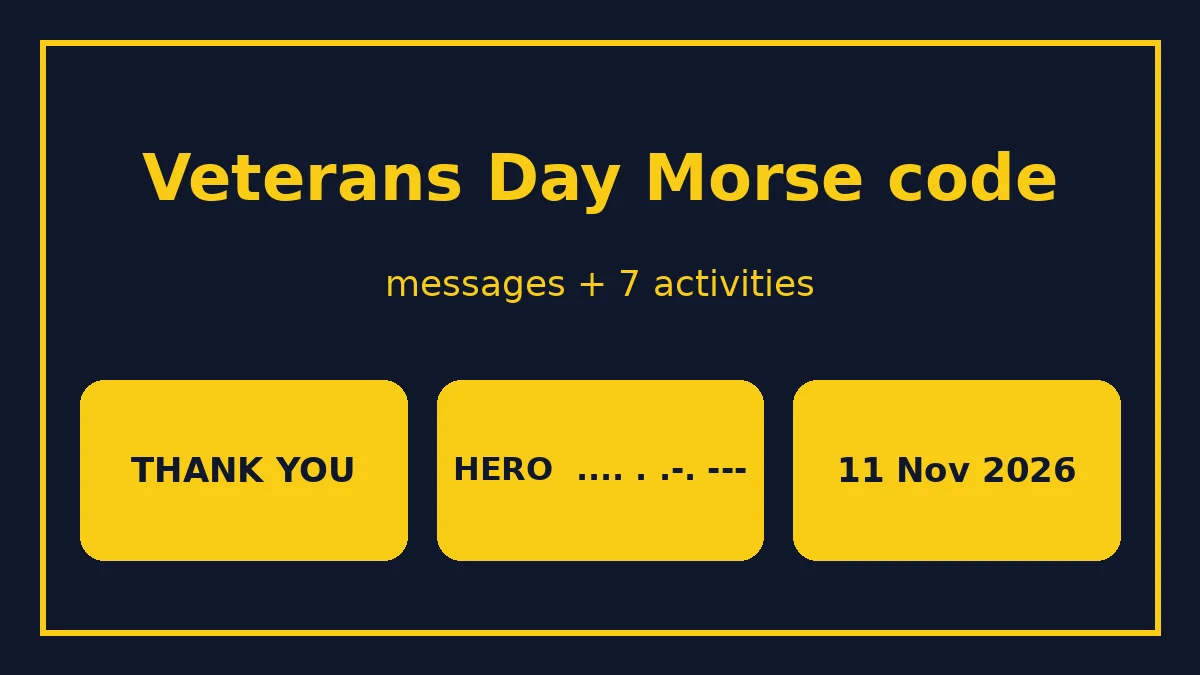
Veterans Day Morse code is a simple way to say thank you in dots and dashes. Below you will find ready-to-copy Morse code for messages such as "THANK YOU", "THANK YOU FOR YOUR SERVICE" and "HONOR", plus seven activities for classrooms, families and community events. Veterans Day 2026 falls on Wednesday, 11 November. Every message here was encoded with the International Morse code table and decoded back to check it.
Morse code has a long link with military service. Soldiers, sailors and aviators sent and received it for well over a century, and our military Morse code history tells that story. A message in Morse is a small way to connect a thank-you to that history.
Why Veterans Day is on 11 November
Veterans Day began as Armistice Day, marking the end of fighting in World War I, which stopped at the 11th hour of the 11th day of the 11th month of 1918. In the United States it was renamed Veterans Day in 1954 to honor all who have served in the armed forces. The U.S. Department of Veterans Affairs explains the history on its Veterans Day pages.
Veterans Day honors all veterans, living and deceased. It is different from Memorial Day in May, which honors those who died in service.
Veterans Day messages in Morse code
Copy any of these into a card, a craft or a classroom slide. A space separates letters and a slash (/) separates words.
| Message | Morse code |
|---|---|
| THANK YOU | - .... .- -. -.- / -.-- --- ..- |
| THANK YOU FOR YOUR SERVICE | - .... .- -. -.- / -.-- --- ..- / ..-. --- .-. / -.-- --- ..- .-. / ... . .-. ...- .. -.-. . |
| HONOR | .... --- -. --- .-. |
| HERO | .... . .-. --- |
| WE REMEMBER | .-- . / .-. . -- . -- -... . .-. |
| FREEDOM | ..-. .-. . . -.. --- -- |
| USA | ..- ... .- |
| BRAVE | -... .-. .- ...- . |
| PROUD | .--. .-. --- ..- -.. |
| 11 11 | .---- .---- / .---- .---- |
You can type any other message, including a veteran's name, into our Morse code translator to get the code and hear it played.
Short messages for small spaces
For bracelets, bookmarks and small cards, shorter words fit better:
- HERO:
.... . .-. --- - USA:
..- ... .- - TY (thank you):
- -.-- - VET:
...- . -
7 Veterans Day Morse code activities
1. Morse code thank-you cards
Write "THANK YOU" in Morse code across the front of a card, with the plain English inside. Students can decorate the dots and dashes with stars and stripes. Many local veterans' organizations and care homes welcome cards; contact them first to ask how they would like to receive them.
2. Bead bracelets
Use two bead colors, one for dots and one for dashes, and a spacer bead between letters. "HERO" or "USA" fits on one bracelet. Our Morse code bracelet page shows the full method.
3. Flashlight message
In a dark room, flash "THANK YOU" with a flashlight: a short flash for a dot, a long flash for a dash. Our light Morse code tool can flash it on screen so students can copy the rhythm. It shows how ships once signaled with lamps.
4. Decode the message
Write a Morse message on the board, such as "WE REMEMBER", and ask students to decode it with a chart. Give the fastest team the job of encoding the next message. Our printable Morse code chart is ready for this.
5. Morse code poster
Create a class poster with each student's thank-you message written in Morse code and English. Display it in the hallway for the week of 11 November.
6. Tap a moment of respect
Many schools hold a moment of silence on Veterans Day. Afterward, a student can tap "HONOR" softly on a desk, a short tap for a dot and a held tap for a dash, as a quiet tribute. Our tapping guide explains how.
7. Interview a veteran
If a family member or neighbor served, students can ask if they ever used Morse code or signals in their service. Not every veteran will have, and that is fine; the conversation about their service is what matters. Write one quote from the interview in English and one word from it in Morse code.
Veterans Day activities by age
Preschool and kindergarten: keep it to one short word such as "USA". Children can glue round stickers for dots and paper strips for dashes onto a card.
Grades 1 to 3: decode "HERO" together as a class, then let each child copy it onto a card. Talk about what makes someone a hero in everyday life.
Grades 4 to 6: students encode their own short message, swap with a partner and decode each other's card. Add the flashlight activity for a hands-on finish.
Grades 7 to 8: students can research how signaling was used in one historical period and present one fact, with a key word from their research written in Morse code.
A Morse code bookmark
Bookmarks are quick to make and easy to give. Cut card stock into strips about 2 inches wide and 7 inches long. Write a short message, such as "HERO" or "THANK YOU", down the strip in Morse code, one letter per line, with the English letter beside it. Punch a hole at the top and add a red, white or blue ribbon. A class can make a stack in one lesson.
Respectful wording tips
A few simple guidelines keep messages thoughtful:
- Keep it sincere and simple. "Thank you for your service" and "We remember" say a lot in a few words.
- Ask before sharing names. If you include a veteran's name on a public display, ask the veteran or their family first.
- Include everyone. Veterans served in many branches and roles, at home and abroad, in peace and in war.
- Avoid assumptions. Not every veteran wants to talk about their service. A card that simply says thank you is always welcome.
Display ideas for school hallways
A Morse code display draws people in because they want to decode it. Line a wall with student cards, each showing a message in Morse code with the English hidden under a paper flap. Add a large printed chart at one end so passers-by can decode the messages themselves. A title such as "Can you read our thank-you?" invites everyone to stop and try.
Community event ideas
Libraries, scout troops and community centers can use Morse code at Veterans Day events:
- Decode station: set up a table with a chart and a few printed messages. Visitors decode one and write a thank-you note in return.
- Sound station: play "THANK YOU" on a laptop through the translator and let visitors guess the message before showing the answer.
- Card drive: collect Morse code thank-you cards and deliver them to a local veterans' group that has agreed to receive them.
- Light display: after dark, a volunteer flashes a short message with a lantern while the group decodes it together.
Keep each station simple, with the chart on the table, so families with young children can join in.
Sending your message on the day
On 11 November, share your message in the way that suits you: give a card in person, read a message aloud at a school assembly, or play the sound of "THANK YOU" in Morse code at the start of a class. Small gestures, made with care, are what make the day meaningful.
Classroom plan: 30 minutes
For grades 3 to 8, this short plan fits a single lesson:
- Introduce (5 minutes): explain why Veterans Day is on 11 November.
- Learn (5 minutes): show a Morse code chart and decode "HERO" together.
- Create (15 minutes): each student writes a thank-you card with one Morse code word.
- Share (5 minutes): volunteers read their message aloud in dits and dahs.
Our Morse code classroom kit has printable worksheets, and Morse code for kids has more beginner activities.
Morse code and military service, briefly
Morse code was used in the American Civil War on telegraph lines, at sea for ship-to-ship and ship-to-shore messages, and by radio operators in both world wars. Signal lamps on ships still use Morse code. For the full history, see our military Morse code and Morse code in WWII articles.
Tips for writing Morse code by hand
- Make dots round and dashes long. A dash should be about three times as long as a dot so they are easy to tell apart.
- Leave clear gaps. Put a small space between letters and a slash between words.
- Write the English too. Add the plain message underneath so everyone can read it.
- Double-check with the translator. Paste your Morse into our Morse to English decoder before you finalize a card or craft.
Hearing your message
A message in Morse code feels different when you hear it. Type your message into the translator and press play. "THANK YOU" has a gentle, steady rhythm; "HONOR" (di-di-di-dit dah-dah-dah dah-dit dah-dah-dah di-dah-dit) has a strong pattern of long signals. Playing the sound for a class before they decode it makes the activity memorable.