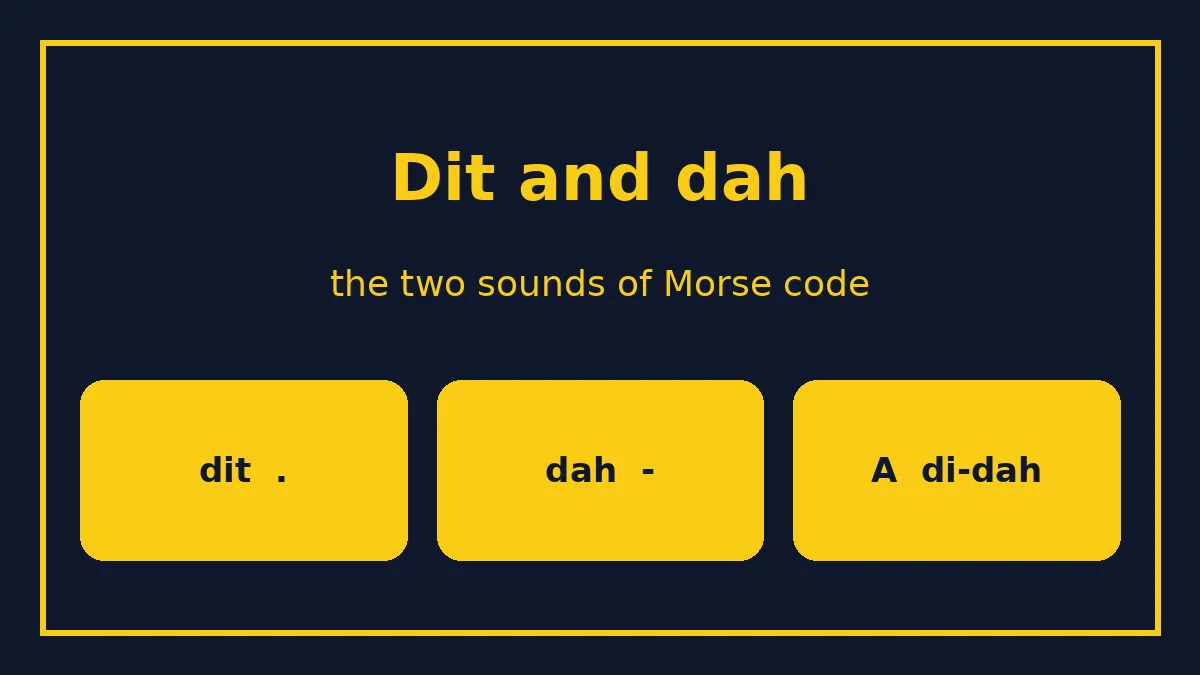
Dit and dah are the spoken names for the two Morse code signals. A dit is the short signal, written as a dot (.), and a dah is the long signal, written as a dash (-). Operators say "dit" and "dah" because Morse code is meant to be heard, not read, and saying the sounds out loud helps you learn each letter as a rhythm. The letter A, for example, is "di-dah" and SOS is "di-di-dit dah-dah-dah di-di-dit".
If you came here from a crossword, the answer is short: "dah's partner in Morse code" is DIT, and "dit's partner" is DAH. The rest of this guide explains where the words come from, how long each sound lasts, how to say every letter and number, and how thinking in dits and dahs makes Morse code much easier to learn.
Dit vs dah: the two Morse code sounds
| Signal | Written | Spoken | Length |
|---|---|---|---|
| Short | dot (.) | dit (or "di" inside a letter) | 1 unit |
| Long | dash (-) | dah | 3 units |
Every letter, number and punctuation mark in International Morse code is a mix of these two signals. The letter E is a single dit, and T is a single dah, which is why they are the shortest letters to send.
Our Morse code translator plays any text as sound, so you can hear the difference between a dit and a dah right away.
Why "dit" becomes "di" in the middle of a letter
When a dit comes at the end of a letter, you say the full word "dit", with a crisp ending. When it comes before another signal in the same letter, the "t" is dropped, so it sounds like "di". That is why B is spoken "dah-di-di-dit" and not "dah-dit-dit-dit".
The reason is speed. At normal sending speeds there is no time to say the "t", and the shortened "di" matches the rhythm better. The dah keeps its full sound because it is three times longer.
How long is a dit and a dah?
Morse code timing is built on one unit, the length of a dit. The international standard, ITU-R M.1677-1 (see our plain-English guide to the standard), sets these rules:
- A dit is 1 unit long.
- A dah is 3 units long.
- The gap between signals inside a letter is 1 unit.
- The gap between letters is 3 units.
- The gap between words is 7 units.
So "SOS" (... --- ...) takes 27 units from the first dit to the last. The standard word "PARIS" takes 50 units including the gap that follows it, which is why it is used to measure speed in words per minute. Our Morse code WPM guide explains how that works.
Every letter in dits and dahs
Use this table to say each letter out loud. Saying "di-dah" while you read .- builds the sound habit from day one.
| Letter | Code | Sounds like | Letter | Code | Sounds like |
|---|---|---|---|---|---|
| A | .- |
di-dah | N | -. |
dah-dit |
| B | -... |
dah-di-di-dit | O | --- |
dah-dah-dah |
| C | -.-. |
dah-di-dah-dit | P | .--. |
di-dah-dah-dit |
| D | -.. |
dah-di-dit | Q | --.- |
dah-dah-di-dah |
| E | . |
dit | R | .-. |
di-dah-dit |
| F | ..-. |
di-di-dah-dit | S | ... |
di-di-dit |
| G | --. |
dah-dah-dit | T | - |
dah |
| H | .... |
di-di-di-dit | U | ..- |
di-di-dah |
| I | .. |
di-dit | V | ...- |
di-di-di-dah |
| J | .--- |
di-dah-dah-dah | W | .-- |
di-dah-dah |
| K | -.- |
dah-di-dah | X | -..- |
dah-di-di-dah |
| L | .-.. |
di-dah-di-dit | Y | -.-- |
dah-di-dah-dah |
| M | -- |
dah-dah | Z | --.. |
dah-dah-di-dit |
A few patterns stand out once you say them:
- Opposites: A (di-dah) and N (dah-dit) are mirror images, as are D (dah-di-dit) and U (di-di-dah), and G (dah-dah-dit) and W (di-dah-dah).
- Counting dits: E, I, S and H are 1, 2, 3 and 4 dits.
- Counting dahs: T, M and O are 1, 2 and 3 dahs.
Numbers in dits and dahs
Every number has exactly five signals, which makes them easy to recognize by rhythm.
| Number | Code | Sounds like |
|---|---|---|
| 1 | .---- |
di-dah-dah-dah-dah |
| 2 | ..--- |
di-di-dah-dah-dah |
| 3 | ...-- |
di-di-di-dah-dah |
| 4 | ....- |
di-di-di-di-dah |
| 5 | ..... |
di-di-di-di-dit |
| 6 | -.... |
dah-di-di-di-dit |
| 7 | --... |
dah-dah-di-di-dit |
| 8 | ---.. |
dah-dah-dah-di-dit |
| 9 | ----. |
dah-dah-dah-dah-dit |
| 0 | ----- |
dah-dah-dah-dah-dah |
Notice the pattern: 1 to 5 begin with dits followed by dahs, 6 to 9 begin with dahs followed by dits, and 0 is five dahs. For a full chart, see our Morse code numbers page.
Why operators think in sounds, not dots
Most beginners learn Morse code from a printed chart and try to "see" each letter. That works at first, but it slows you down later. When you hear a letter, your brain has to turn the sound into dots and dashes, then look up the picture, then find the letter. Experienced operators skip the middle steps: they hear "di-dah" and know it is A, the same way you recognize a spoken word.
This is why most training methods, including the Koch method and Farnsworth spacing, teach by ear from the start. Saying dits and dahs out loud is the bridge between the chart and the sound.
How to practice with dit and dah
- Say it as you read. Every time you look at a letter on the chart, say its sound out loud.
- Listen first. Play letters in our Morse code trainer and say the letter before you look.
- Start with short letters. E, T, I, M, A and N are one or two signals each.
- Hum words. Hum your name in dits and dahs while you walk or wait in line.
- Use rhythm, not counting. Do not count the dits in H. Learn the sound of "di-di-di-dit" as one chunk.
- Practice a little every day. Ten minutes a day works better than one long session a week.
Our guide on how long it takes to learn Morse code has realistic timelines.
Famous Morse sounds you may already know
- SOS: di-di-dit dah-dah-dah di-di-dit. The distress signal is sent as one continuous signal, with no letter gaps. Read more on our SOS Morse code page.
- CQ: dah-di-dah-dit dah-dah-di-dah. Radio operators send CQ to call any station.
- E: a single dit, the most common letter in English.
- T: a single dah.
- "V" for victory: di-di-di-dah, which has the same short-short-short-long rhythm as the opening of Beethoven's Fifth Symphony.
Dits and dahs beyond letters
Prosigns are special signals sent as one run, without letter gaps, to manage a conversation. They use the same dits and dahs:
- AR (end of message):
.-.-., said di-dah-di-dah-dit. - SK (end of contact):
...-.-, said di-di-di-dah-di-dah. - BT (break, new paragraph):
-...-, said dah-di-di-di-dah.
See our Morse code prosigns page for the full list. Punctuation works the same way; our Morse code punctuation page lists each mark.
Dit, dah and crosswords
Dit and dah show up in crosswords because they are short, use common letters and have a clear clue. Common clues and answers:
| Clue | Answer |
|---|---|
| Dah's partner in Morse code | DIT |
| Dit's partner | DAH |
| Morse code "dot" | DIT |
| Morse code "dash" | DAH |
| Dot's partner | DASH |
| Morse code bit | DIT or DAH |
Check the number of letters and any crossing answers before you write it in. "Dot" and "dash" are four letters; "dit" and "dah" are three.
Dit and dah in other signals
The same short and long idea works in any medium. A flashlight can show a short flash for a dit and a long flash for a dah, which our light Morse code tool demonstrates. Tapping on a table uses a quick tap for a dit and a slightly held tap or a double tap for a dah; our tapping guide explains the options. In every case, the dah is about three times the length of the dit.
Teaching dit and dah to children
Children pick up dits and dahs quickly when it feels like a game. Clap short and long beats for each letter, or have them say their initials in dits and dahs. A child named Ava can learn "di-dah, di-di-di-dah, di-dah" in a minute. Our Morse code for kids page has more games that build on this.
Common mistakes with dits and dahs
- Making the dah too short. A dah should be about three times a dit. If it is only twice as long, listeners confuse A with E-T.
- Rushing the gaps. The 3-unit gap between letters is what separates "ET" from "A". Without it, letters run together.
- Counting instead of hearing. Counting four dits for H works at very slow speeds and fails as you speed up.
- Learning visually only. If you can read the chart but not hear the letters, switch to sound-first practice.