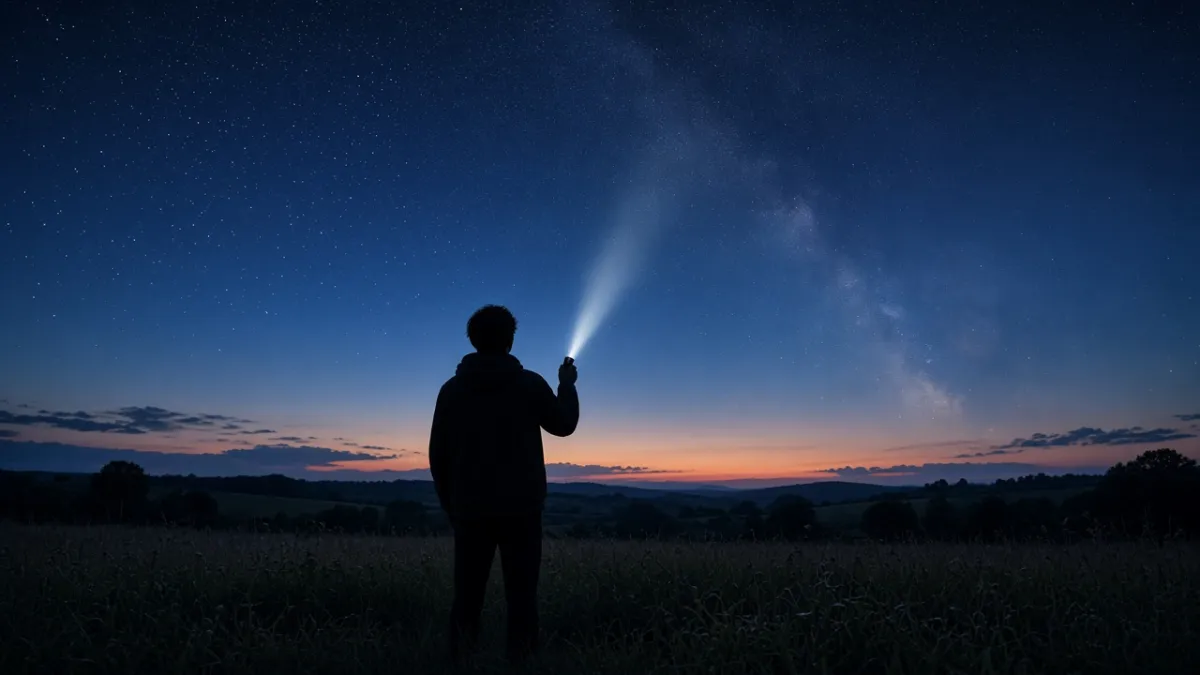
VGR in Morse code is ...- --. .-. — that is V (dit-dit-dit-dah), G (dah-dah-dit) and R (dit-dah-dit). VGR is the three-letter call sign for NASA's Voyager mission. In November 2026 NASA invited people around the world to flash those three letters at the sky with a flashlight or phone to celebrate Voyager 1 becoming the first human-made object to reach one light-day from Earth.
This guide shows the VGR pattern letter by letter, how to flash it with a light, how long it takes at different speeds, and the story behind the milestone. If you want to hear or see it right away, type "VGR" into our Morse code translator or the light Morse code translator, which flashes your message on screen.
VGR in Morse code at a glance
| Letter | Morse | Spoken as | Light flashes |
|---|---|---|---|
| V | ...- |
dit-dit-dit-dah | three quick, one long |
| G | --. |
dah-dah-dit | two long, one quick |
| R | .-. |
dit-dah-dit | quick, long, quick |
Written together with the usual spaces between letters, the full call sign is:
...- --. .-.
Each letter has its own page with audio and memory tips: V in Morse code, G in Morse code and R in Morse code. The whole alphabet is on our Morse code alphabet chart.
Why VGR? The Voyager call sign
Every Morse signal needs a short identifier, and NASA describes VGR as the three-letter call sign for the Voyager mission. It is easy to see why it works well as a light signal. The three letters are short, they look nothing alike in Morse, and together they make a pattern with a clear rhythm: a run of quick flashes, a pair of long ones, then a short-long-short finish.
A V also has a long history in Morse. Its "three short, one long" rhythm is often compared to the famous opening of Beethoven's Fifth Symphony, which makes it one of the easiest letters to remember by sound.
The milestone: Voyager 1 reaches one light-day
Voyager 1 launched on Sept. 5, 1977. According to NASA, it was scheduled to reach one light-day from Earth on Wednesday, Nov. 18, 2026, at 5:16:07 a.m. EST, after 49 years, two months and 11 days of travel. No other human-made object has gone that far.
A light-day is a distance, not a time. It is how far light travels in 24 hours. NASA gives the figure as 16,094,799,096 miles (25,902,068,356 kilometers), or about 16 billion miles. Because radio signals also travel at the speed of light, a command sent from Earth now takes a whole day to reach the spacecraft.
Some other facts NASA shares about the journey:
- Voyager 1 entered interstellar space in August 2012.
- It is cruising at nearly 38,000 mph (61,000 kph).
- Its twin, Voyager 2, is on pace to reach one light-day in November 2035.
"Shine Bright for Voyager": what NASA asked people to do
NASA called the event "Shine Bright for Voyager's Light-Day." After sunset on Tuesday, Nov. 17, 2026, people everywhere were invited to point a light at the sky and flash V-G-R in Morse code, creating what NASA called a worldwide wave of golden light. NASA also offered an automated flasher web page that blinks the call sign from a phone or tablet.
The flashes were never meant to reach the spacecraft; Voyager 1 is far too distant for a flashlight. It was a symbolic salute, a way for anyone to take part in a once-in-history moment using one of the oldest digital codes there is. The good news is that you can still flash VGR any clear evening. The pattern does not expire.
Read NASA's full guide to the event on the Shine Bright for Voyager's Light-Day page.
How to flash VGR with a flashlight or phone
You can use a flashlight, a phone torch, a bike light or a lantern. NASA suggested using the switch or simply covering the light with your hand or a piece of cardboard.
- Point your light at the sky and get comfortable. A dark spot away from streetlights makes your flashes easier for others to see.
- Flash V: three quick flashes, then one long flash (
...-). - Pause for a second or more.
- Flash G: two long flashes, then one quick flash (
--.). - Pause again.
- Flash R: one quick, one long, one quick (
.-.). - Pause a little longer, then repeat. NASA suggested repeating for around a minute.
NASA's simple guide treats a dot as a quick flash of less than a second and a dash as a flash of about one second, with a brief pause between the parts of a letter and a pause of a second or more between letters. That is perfect for a beginner with a flashlight.
If you want to send it like a trained operator, use the standard timing instead. Our blinking Morse code guide uses the same short-and-long idea with your eyes, which is a fun way to practise the rhythm before you pick up a light.
Getting the timing right
International Morse code is built on one basic unit of time. A dot is one unit, a dash is three units, the gap inside a letter is one unit, the gap between letters is three units, and the gap between words is seven units. Our Morse code timing guide explains this in full.
Counting in those units, one VGR takes 31 units:
- V: 1 + 1 + 1 + 1 + 1 + 1 + 3 = 9 units
- gap: 3 units
- G: 3 + 1 + 3 + 1 + 1 = 9 units
- gap: 3 units
- R: 1 + 1 + 3 + 1 + 1 = 7 units
Using the standard formula (one unit lasts 1.2 seconds divided by the words-per-minute speed), that works out to:
| Speed | Length of one unit | Time for one VGR |
|---|---|---|
| 5 WPM | 0.24 seconds | about 7.4 seconds |
| 10 WPM | 0.12 seconds | about 3.7 seconds |
| 20 WPM | 0.06 seconds | about 1.9 seconds |
For flashlight signalling, slower is better. At around 5 words per minute, people watching can follow every flash. Add a seven-unit pause before each repeat so the signal does not run together. To see what different speeds feel like, try our Morse code WPM guide.
Practise VGR before you flash it
A minute of practice makes your signal much cleaner. Try this short routine:
- Listen first. Play VGR a few times in the Morse code translator and say it out loud: "di-di-di-dah, dah-dah-dit, di-dah-dit." Hearing the rhythm is easier than counting dots.
- Tap it. Tap the pattern on a table with one finger, keeping the long taps clearly longer than the short ones.
- Use the on-screen key. Our virtual Morse code keyboard lets you key the letters and hear your timing.
- Then add the light. Switch to a flashlight only when the rhythm feels natural.
If you enjoy it, the same steps work for any short word. Many beginners move on to their own initials or names next.
Common mistakes when flashing VGR
- Dashes that are too short. A dash should be clearly longer than a dot, about three times as long. If your dashes and dots look the same, the message turns into a blur of flashes.
- No gap between letters. Without a pause,
...-followed by--.can look like other letters entirely. Morse depends on spacing, a problem our page on decoding Morse without spaces explores in detail. - Rushing. Steady, even flashes are more readable than fast ones.
- Mixing up V and U. U is
..-(two dits and a dah). V has three dits before the dah.
Voyager already carries Morse code
This was not Voyager's first brush with Morse. NASA notes that the Golden Record, the message carried by both Voyager 1 and Voyager 2 with music, sounds and greetings from Earth, includes a Morse code message: "Ad astra per aspera," Latin for "through struggle to the stars."
Here is that phrase in International Morse code (words separated by /):
.- -.. / .- ... - .-. .- / .--. . .-. / .- ... .--. . .-. .-
At 5 words per minute it would take about 35 seconds to send by light. It makes a good next challenge once VGR feels easy.
Turn VGR into a family or classroom activity
Flashing VGR is a simple, screen-free way to introduce Morse code and space science at the same time. A few ideas:
- Flash and decode. One person flashes VGR or another short call sign; the others write down dots and dashes and decode them with a chart.
- Make a call sign. Ask everyone to invent their own three-letter call sign and flash it.
- Draw the distance. Talk about what a light-day means: sunlight takes about eight minutes and 20 seconds to reach Earth, but a signal to Voyager 1 now takes a full day.
Our Morse code for kids guide and Morse code classroom kit have printables that fit this kind of lesson.
Other short signals worth knowing
Call signs like VGR are a reminder that Morse is still used to identify stations. Pilots, for example, hear navigation beacons identify themselves in Morse, as our Morse code in aviation article explains. Radio amateurs sign off with 73 in Morse code, and the best-known signal of all is SOS: ... --- ....
Send VGR yourself
The easiest way to get VGR right is to hear and see it first. Type "VGR" into the Morse code translator to play the sound, or use the light Morse code translator to watch the flashes. Then pick up a flashlight on the next clear night, point it at the sky and send ...- --. .-. for the farthest traveller humans have ever launched.